
⚠ Since January 2025, a Missing Certificate Gets Your Saudi Shipment Re-Exported
Saudi Arabia’s compliance requirements have tightened significantly. Letters of Undertaking that previously allowed shipments to enter pending documentation are no longer accepted. Certificates obtained after arrival are now treated as regulatory non-compliance.
If a product reaches Saudi customs without the required documentation registered in the SABER system, the consequence is re-export rather than delay or penalty. In practice, this means the shipment is returned at the importer’s expense, creating both financial loss and supply chain disruption.
Ensuring full compliance before shipment is now a prerequisite for market entry rather than a post-arrival correction.
Effective January 1, 2025: All shipments to Saudi Arabia require both a Product Certificate of Conformity (PCoC) and a Shipment Certificate of Conformity (SCoC) issued through the SABER platform. Letters of Undertaking are no longer accepted for customs clearance. Obtaining certificates post-arrival is considered a violation, risking shipment re-export.
Effective September 15, 2025: A new list of HS codes now requires importers to provide a declaration approved by the Ministry of Industry and Mineral Resources when requesting SCoCs via SABER. If your product falls under the new HS codes, additional documentation is required before your shipment certificate can be issued.
Why QIMA for SASO Certification?
SASO-approved Conformity Assessment Body (CAB) since 2017 — certificates your shipments need to clear Saudi customs: QIMA is an official SASO-approved Conformity Assessment Body, authorized to issue both Product Certificates of Conformity (PCoC) and Shipment Certificates of Conformity (SCoC) through the SABER platform. Certificates are issued within the SASO-recognized framework, reducing the risk of rejection at customs.
Independently accredited to ISO/IEC 17065:2012 by the Saudi Accreditation Center: QIMA holds SAAC accreditation covering SASO and SFDA scopes for the Middle East region, the highest independent verification that our certification process meets international standards.
Global coverage across all major exporting regions: QIMA is authorized to issue SASO certificates for products exporting from Asia & Australia, Europe, the Americas, Middle East & North Africa, and Sub-Saharan Africa. One certification partner, regardless of where your product is manufactured.
End-to-end SABER management — from product registration to shipment clearance: QIMA handles both PCoC and SCoC issuance through the SABER platform. You deal with one partner from initial application through to customs clearance — no gaps in your documentation chain.
Expert guidance on which regulations apply to your product: With every new HS code list and technical regulation update, knowing exactly what your product requires is half the compliance challenge. QIMA's certification experts identify the applicable technical regulations, required documentation, and approval type before your application is submitted.
How QIMA SASO Certification Works
Step 1: Tell us your product and target market
Share your product details, HS code, and Saudi market requirements. QIMA certification experts determine whether your product falls under SASO technical regulations and identify exactly which certificates and documentation are required.
Step 2: Compliance requirements confirmed
For regulated products, QIMA confirms the applicable Technical Regulations, required test reports, inspection scope, and approval type (1a, 3, or 5). You receive a clear checklist of requirements before testing begins, eliminating mid-process uncertainty.
Step 3: Testing and factory audit conducted
QIMA performs required product testing and/or factory audit in accordance with SASO standards. All results are documented in the format required for SABER submission. For non-regulated products, guidance is provided for the self-declaration process.
Step 4: Product Certificate of Conformity (PCoC) issued
QIMA submits compliance documentation through the SABER platform and issues the PCoC, valid for 12 months and covering all shipments of the certified product during that period. Regulated products must hold a valid PCoC before any Shipment Certificate can be issued.
Step 5: Shipment Certificate of Conformity (SCoC) issued per consignment
For each shipment, regulated or non-regulated, QIMA issues an SCoC through SABER. The certificate is verified by the FASAH customs system, enabling customs clearance at Saudi ports without manual documentation at the border.
SASO-Approved Certificates for Saudi Market Entry. Issued Through SABER
QIMA is an official SASO-approved Conformity Assessment Body, accredited by SAAC to ISO/IEC 17065. Apply for your PCoC and SCoC, and ensure your shipments clear Saudi customs without delays or re-export risk.
Understanding the SABER Platform
SABER is Saudi Arabia’s official conformity assessment platform used to issue and verify Product Certificates of Conformity (PCoC) and Shipment Certificates of Conformity (SCoC). All products entering the Saudi market are processed through this system, whether regulated or non-regulated. SABER assigns compliance pathways and determines the documentation required based on product classification and risk level, which directly impacts approval timelines and customs clearance.
QIMA manages the end-to-end SABER workflow on behalf of importers, including product registration, submission of compliance documentation, coordination of required assessments, and issuance of certificates through the platform. This ensures that requirements are handled in advance of shipment departure, reducing the risk of delays or rejection at Saudi customs.
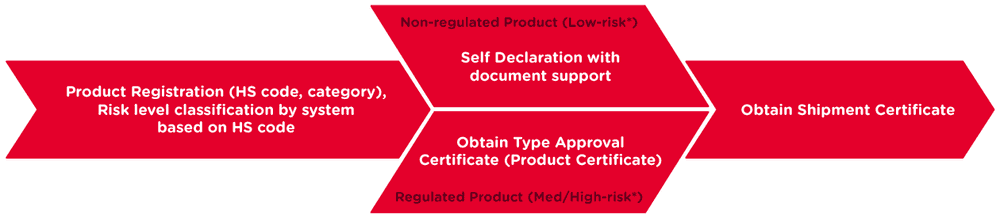
Product Registration
The importer inputs details of the product into SABER
The SABER system verifies if the product is regulated or not based on HS code or product category
Type Approval Certificate (Product Certificate of Conformity)
Scope: Products that are regulated by Saudi Arabia TR. Click here for a list of technical regulations. For products not regulated by Saudi Arabia TR, self-declaration according to the approved forms by SASO is sufficient – , Type Approval Certificates are not needed.
Validity: One year
Required documents:
Conformity documents such as test reports, quality certificates, business license of the manufacturer, Importer and Manufacturer declaration of conformity, risk assessment reports, inspection factory audit report etc., if applicable
Rating label, design, dimensions, plans, specification photo of the products, if applicable
The Type Approval Certificate will be issued through the SABER system after compliance to relevant standards is proven and after approval by SASO Approved Conformity Assessment Body.
Shipment Certificate of Conformity
Scope: All products
Validity: Per consignment
Required documents:
Type Approval Certificate or self-declaration
Shipment document, such as invoice, packing list etc.
A Shipment Certificate is required for each consignment. Issuance of Shipment Certificates for shipments of non-regulated products and regulated products are done through SABER.
On July 1, 2020 the SABER platform was linked with the FASAH system. This integration ensures the automatic verification of Shipment Certificates – there is no need to print a Shipment Certificate of Conformity (SCoC) as it will automatically be in the FASAH system. Any shipment to Saudi Arabia that does not have an SCoC will be required to be re-exported.
SASO Approved Technical Regulations
QIMA is able to approve Product Certificates of Conformity for a number of product categories. The table below contains details on these SASO approved Technical Regulations, their scope and type of approval.
A note on approval types: Approval types 1a, 3 and 5 refer to the assessment types defined in ISO/IEC 17067. Different conformity assessment activities are required for each type as applicable:
Type 1a: Product testing / inspection
Type 3: Product testing / factory inspection / audit
Type 5: Product testing / factory inspection / surveillance factory audit
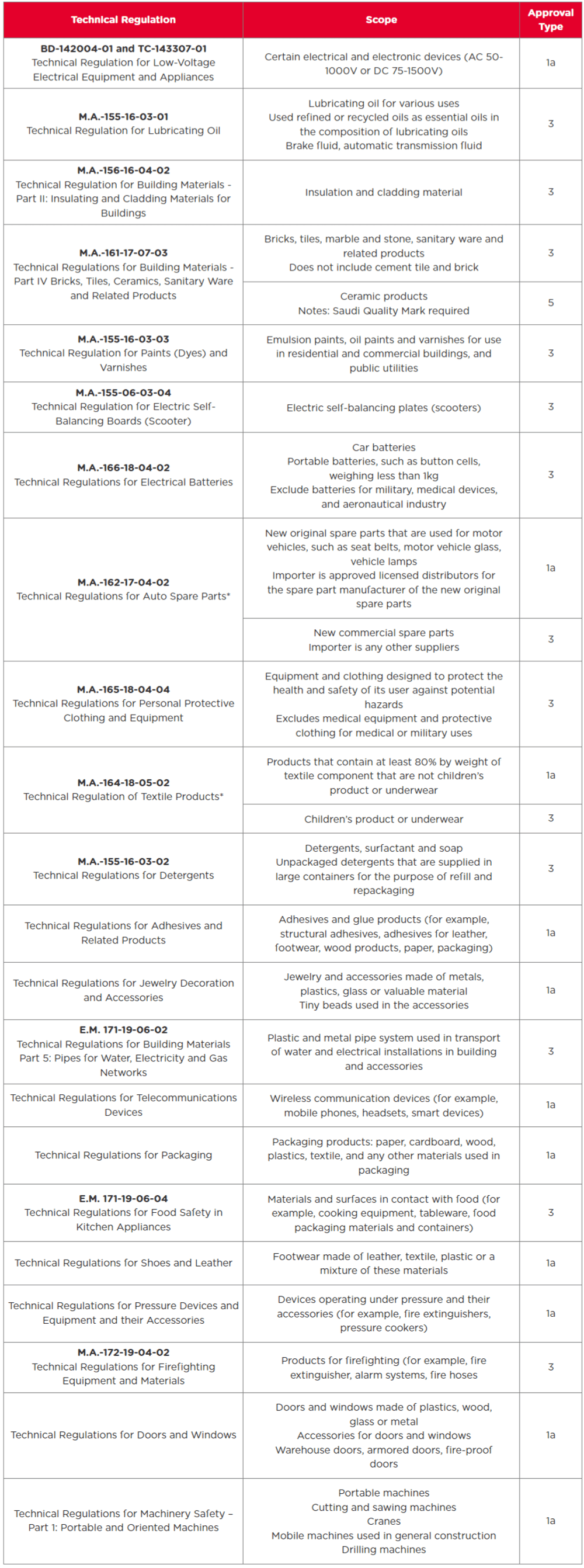
*Textile Products & Auto Spare Parts are subject to a Categorized Conformity Assessment which enables similar products to be grouped together covered by a single PCoC. This effectively reduces the number of PCoCs required for importing products into Saudi Arabia and streamlines the certification process.
For a full list of SASO approved Technical Regulations, click here.
Trusted by 30,000 Brands to Get Testing Right
30,000
Clients worldwide
100+
Countries covered
6,000+
Field and lab experts
72
Net Promoter Score
QIMA is a SASO-approved Conformity Assessment Body, independently accredited by the Saudi Accreditation Center (SAAC) to ISO/IEC 17065:2012, authorized to issue PCoCs and SCoCs through SABER for products exporting from Asia, Europe, the Americas, the Middle East, and Africa.
Frequently Asked Questions
1. How much does SASO certification cost?
Pricing depends on product category, applicable Technical Regulations, and approval type (1a, 3, or 5). QIMA provides fixed-fee quotes with no hidden costs. You can request a quote online and typically receive pricing within 24 hours.
2. How long does SASO certification take?
Timelines vary depending on product type, approval route, and whether testing or factory inspection is required. Type 1a (product testing only) is typically faster than Types 3 or 5, which include inspections or surveillance. QIMA confirms the expected timeline once the certification plan is agreed, especially for shipments with fixed departure dates.
3. How do I know if my product needs a Product Certificate of Conformity?
Regulated products covered by a SASO Technical Regulation require a Product Certificate of Conformity (PCoC) issued by an approved Conformity Assessment Body such as QIMA. Non-regulated products require a self-declaration and Shipment Certificate of Conformity (SCoC). Product classification is confirmed using HS code and category within 24 hours.
4. My product isn’t regulated. Do I still need documentation for Saudi customs?
Yes. All shipments to Saudi Arabia require a Shipment Certificate of Conformity (SCoC) issued through SABER. Without an SCoC, shipments may be subject to re-export. QIMA can issue SCoCs for non-regulated products and guide the self-declaration process.
5. How long is a SASO certificate valid?
A Product Certificate of Conformity (PCoC) is valid for 12 months and covers all shipments of the certified product within that period. An SCoC is issued per shipment and must be obtained for each consignment, even when a valid PCoC exists.
6. What happens if my product fails testing?
A detailed failure report identifies the unmet requirement and cause. QIMA technical teams provide corrective guidance such as design, material, or labeling changes. Retesting can be performed once corrections are implemented, but a PCoC cannot be issued until full compliance is achieved.
7. Do I need to register on SABER myself?
Importers of regulated products must register in SABER to initiate certification. QIMA supports registration and manages the end-to-end process, including product submission, documentation upload, and certificate coordination.
8. Can QIMA certify products manufactured in any country?
QIMA is authorized to issue SASO certifications for products manufactured across Asia, Europe, the Americas, the Middle East & North Africa, and Sub-Saharan Africa. Coverage for specific manufacturing locations can be confirmed on request.
Need more information?
By contacting QIMA you agree to our privacy policy and terms and conditions.
More Resources:
Webinar: Saudi Market Access Essentials: SALEEM Registration & SABER Compliance