July 2026

North America News
The California Department of Toxic Substances Control (DTSC) has officially added microplastics to its Candidate Chemicals List. This administrative step does not immediately impose new requirements on manufacturers or retailers. The DTSC will now evaluate consumer products containing microplastics and consider future regulatory actions where warranted. Economic operators producing goods that shed microplastics should prepare for potential future scrutiny.
On 18 June 2026, the California Department of Toxic Substances Control (DTSC) took action in response to the severe environmental persistence of microplastics and their detection in ecosystems and human tissue by placing microplastics on the Candidate Chemicals List under the Safer Consumer Products program. Under this program, California establishes the legal foundation for future regulatory action. The agency will conduct research to identify specific product and chemical combinations that pose a risk. If a combination is identified, it will be proposed as a Priority Product. Any proposed rulemaking to list a Priority Product containing or generating microplastics would begin with a public announcement, workshop, and comment period to seek input from interested parties before the formal rulemaking process.
Currently, no specific consumer products are subject to new compliance requirements. The regulation broadly concerns any consumer product sold in California that might contain or release microplastics during use.
Illinois enacted the Chemicals in Cosmetic Products Act on 10 July 2026 which prohibits the manufacture and sale of cosmetic products containing specific intentionally added chemicals starting from 1 July 2028.
On 10 July 2026, Illinois enacted Public Act 104-0545 (HB 3409): The Chemicals in Cosmetic Products Act. This Act bans manufacturing, selling, delivering, holding, or offering for sale cosmetic products in Illinois that contain the following intentionally added ingredients:
| Entry | Chemical Name | CAS number |
|---|---|---|
| 1 | Dibutyl phthalate | 84-74-2 |
| 2 | Diethylhexyl phthalate | 117-81-7 |
| 3 | Formaldehyde | 50-00-0 |
| 4 | Paraformaldehyde | 30525-89-4 |
| 5 | Methylene glycol | 463-57-0 |
| 6 | Quaternium-15 | 51229-78-8 |
| 7 | Mercury | 7439-97-6 |
| 8 | Isobutylparaben | 4247-02-3 |
| 9 | Isopropylparaben | 4191-73-5 |
| 10 | m-Phenylenediamine and its salts | 108-45-2 |
| 11 | o-Phenylenediamine and its salts | 95-54-5 |
PFAS Substances (Per- and Polyfluoroalkyl Substances)
| Entry | Chemical Name | CAS number |
|---|---|---|
| 12A | Perfluorooctane sulfonate (PFOS) / Heptadecafluorooctane-1-sulfonic acid | 1763-23-1 |
| 12B | Potassium perfluorooctanesulfonate / Potassium heptadecafluorooctane-1-sulfonate | 2795-39-3 |
| 12C | Diethanolamine perfluorooctane sulfonate | 70225-14-8 |
| 12D | Ammonium perfluorooctane sulfonate / Ammonium heptadecafluorooctanesulfonate | 29081-56-9 |
| 12E | Lithium perfluorooctane sulfonate / Lithium heptadecafluorooctanesulfonate | 29457-72-5 |
| 12F | Perfluorooctanoic acid (PFOA) | 335-67-1 |
| 12G | Ammonium pentadecafluorooctanoate | 3825-26-1 |
| 12H | Nonadecafluorodecanoic acid | 335-76-2 |
| 12I | Ammonium nonadecafluorodecanoate | 3108-42-7 |
| 12J | Sodium nonadecafluorodecanoate | 3830-45-3 |
| 12K | Perfluorononanoic acid (PFNA) | 375-95-1 |
| 12L | Sodium heptadecafluorononanoate | 21049-39-8 |
| 12M | Ammonium perfluorononanoate | 4149-60-4 |
Additional states, including Maryland and California, ban this same baseline list of intentionally added cosmetic chemicals, though California has since expanded its restrictions to cover additional substances.
Exemptions apply for technically unavoidable trace quantities resulting from impurities, manufacturing processes, or storage, provided the product was manufactured with the intent to comply.
The effective date is 1 July 2028.
In the US, when hazards are identified in consumer products, they will be recalled and published in the Consumer Product Safety Commission (CPSC) Recent Recalls on the CPSC website, which is updated daily. The US recalls from 01 June 2026 to 30 June 2026 are summarized below:
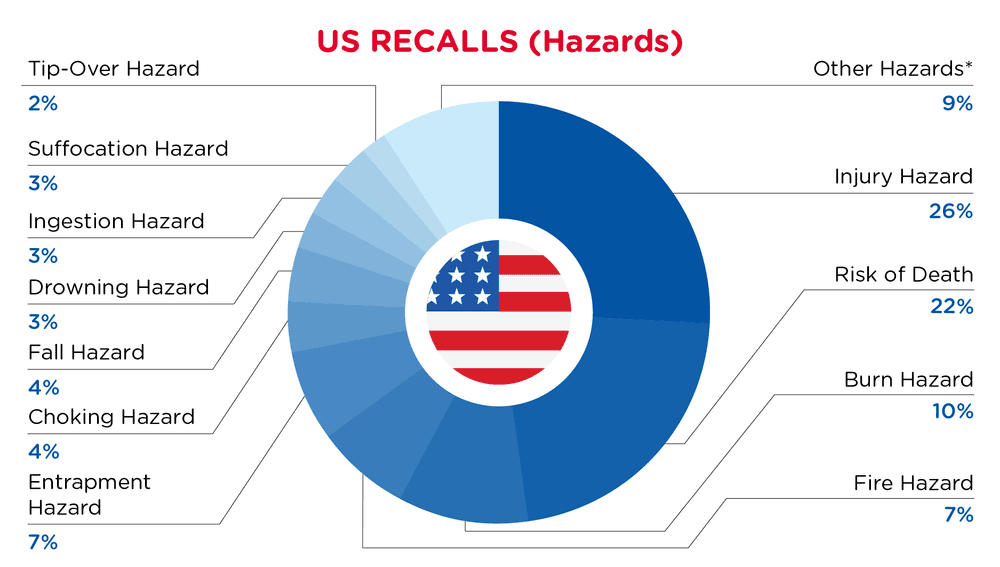
| Hazards | Frequency |
|---|---|
| Injury Hazard | 35 |
| Risk of Death | 29 |
| Burn Hazard | 14 |
| Fire Hazard | 9 |
| Entrapment Hazard | 9 |
| Choking Hazard | 5 |
| Fall Hazard | 5 |
| Drowning Hazard | 4 |
| Ingestion Hazard | 4 |
| Suffocation Hazard | 4 |
| Tip-Over Hazard | 3 |
| Other Hazards* | 12 |
*Other Hazards include Poisoning Hazard, Chemical Hazard, Laceration Hazard, Crash Hazard, Crushing Hazard, Skin Irritation Risk, Electric Shock Hazard, Explosion Hazard and Eye Irritation Risk with a frequency of less than 2.
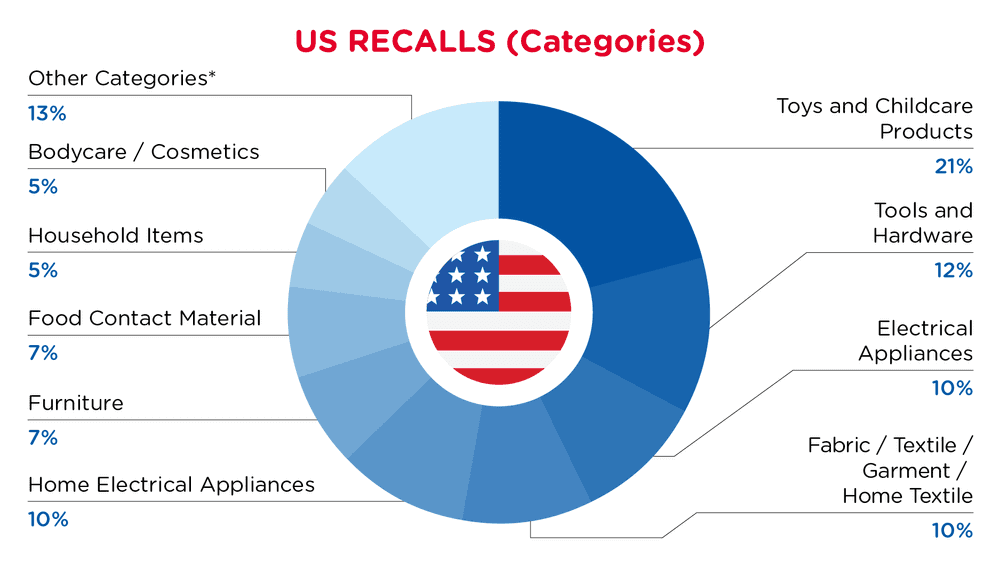
| Product Categories | Frequency |
| Toys and Childcare Products | 8 |
| Tools and Hardware | 5 |
| Electrical Appliances | 4 |
| Fabric / Textile / Garment / Home Textile | 4 |
| Home Electrical Appliances | 4 |
| Furniture | 3 |
| Food Contact Material | 3 |
| Household Items | 2 |
| Bodycare / Cosmetics | 2 |
| Other Categories* | 5 |
*Other Categories include Outdoor Living Items, Computer / Audio / Video / Other Electronics & Accessories, Sporting Goods / Equipment, Footwear and Protective Equipment with a frequency of less than 4.
For a complete list, click here.
In Canada, when hazards are identified in consumer products, they will be recalled and published in the Recalls and Safety Alerts Database on the Health Canada website, which is updated daily. The Canada recalls from 01 June 2026 to 30 June 2026 are summarized below:
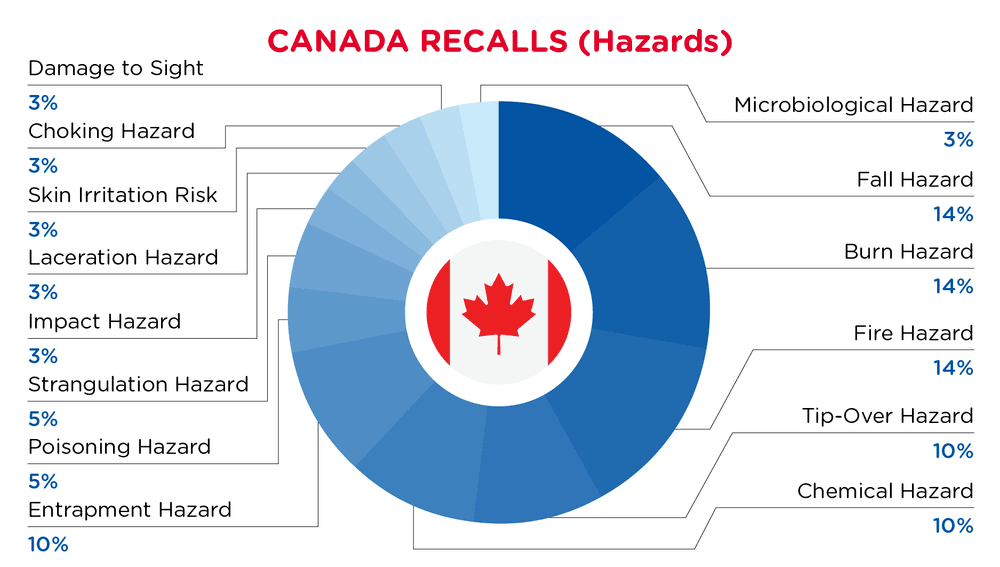
| Hazards | Frequency |
|---|---|
| Fall Hazard | 4 |
| Burn Hazard | 4 |
| Fire Hazard | 4 |
| Tip-Over Hazard | 3 |
| Chemical Hazard | 3 |
| Entrapment Hazard | 3 |
| Poisoning Hazard | 2 |
| Strangulation Hazard | 2 |
| Impact Hazard | 1 |
| Laceration Hazard | 1 |
| Skin Irritation Risk | 1 |
| Choking Hazard | 1 |
| Damage to Sight | 1 |
| Microbiological Hazard | 1 |
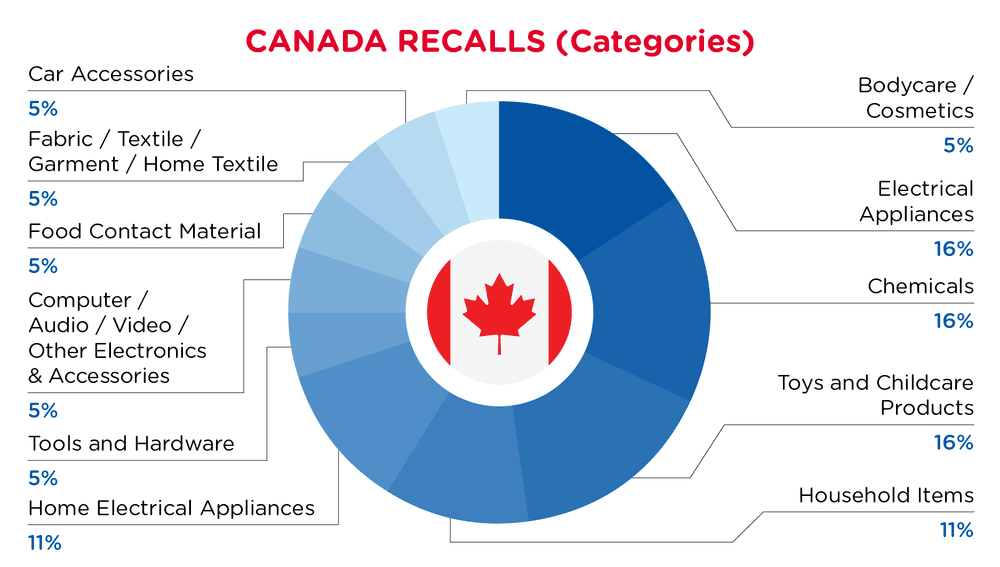
| Product Categories | Frequency |
|---|---|
| Electrical Appliances | 3 |
| Chemicals | 3 |
| Toys and Childcare Products | 3 |
| Household Items | 2 |
| Home Electrical Appliances | 2 |
| Tools and Hardware | 1 |
| Computer / Audio / Video / Other Electronics & Accessories | 1 |
| Food Contact Material | 1 |
| Fabric / Textile / Garment / Home Textile | 1 |
| Car Accessories | 1 |
| Bodycare / Cosmetics | 1 |
For a complete list, click here.
Europe News
The updated version of test standards EN ISO 12870 for spectacle frames and EN ISO 12312-1 that defines safety, optical, and construction requirements for non-prescription sunglasses and clip-ons are officially harmonized for the European Union.
Spectacle frame test requirements EN ISO 12870:2025 published in 2025 are now official and mandatory in the European Union (EU). Referring to the current Official Journal dated 17 June 2026, EN ISO 12870:2025 replaces EN ISO 12870:2018, with an effective date beginning 17 June 2026.
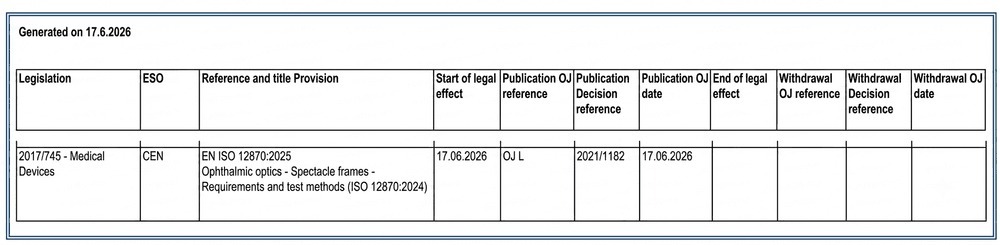
Test requirements for sunglasses, EN ISO 12312-1:2022+A11:2024 published in 2022 and amended in 2024, are also officially mandatory in the EU.
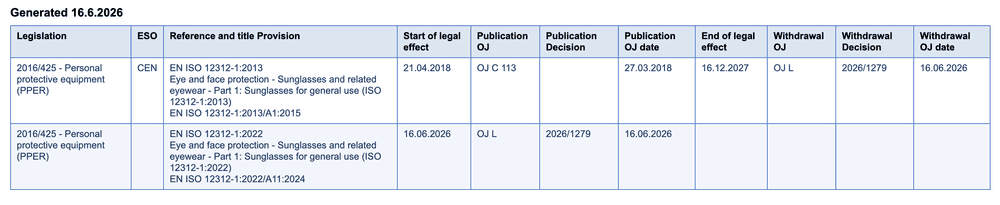
Referring to the current Official Journal dated 16 June 2026, EN ISO 12312-1:2022+A11:2024 (harmonized European standard for afocal (non-prescription) sunglasses and clip-ons for general, everyday use) replaces EN ISO 12312-1:2013+A1:2015 harmonized international standard defining the optical, mechanical, and physical safety requirements for non-prescription sunglasses and clip-ons for general, everyday use) with an effective date from 16 June 2026.
EN ISO 12312-1:2013+A1:2015 will be legally withdrawn on 16 December 2027 with a transition period of 1.5 years.
The Joint Research Centre (JRC) of the European Commission published in May 2026, a “Study on Digital Product Passport (DPP) content for textile apparel products under the Ecodesign for Sustainable Products Regulation (ESPR)”. The study identifies structured DPP data points across four content categories, a tiered granularity framework, a three-tier access rights model, and data governance principles to inform a forthcoming delegated act expected tentatively in 2027. Economic operators in the textile apparel sector, particularly manufacturers, importers, and distributors, should begin monitoring developments closely in preparation for anticipated DPP compliance obligations.
The Ecodesign for Sustainable Products Regulation (ESPR) (EU) 2024/1781 entered into force on 18 July 2024, establishing a horizontal framework for the sustainability of physical goods placed on the European Union (EU) market. The Digital Product Passport (DPP) introduced under Article 9 and Annex III ESPR, is the primary mechanism to operationalize product information requirements in a digital, structured, and accessible format. It also serves as the default digital tool for market surveillance compliance documentation under Articles 4(6)(iii) and 36(3) ESPR.
Textile apparel has been explicitly prioritized in the Commission's first ESPR Working Plan (2024–2030), and a dedicated delegated act is expected tentatively in 2027. A study on DDP content for textile apparel products under the ESPR was published by the Joint Research Centre (JRC) in May 2026. Two key infrastructure milestones are approaching: the EU DPP Registry (Article 13 ESPR) is to be established by 19 July 2026, and the ESPR Web Portal (Article 14 ESPR) which will provide public and role-based access to DPP information across product groups.
1. What products are affected?
The DPP obligation will apply to textile apparel products placed on the EU market, defined as containing at least 80% textile fibers by weight. Products in scope cover ten garment categories:
T-shirts
Shirts and blouses
Sweaters and mid-layers
Jackets and coats
Pants and shorts
Dresses, skirts and jumpsuits
Leggings, stockings, tights and socks
Underwear
Swimwear
Textile apparel accessories
Technical apparel (workwear, sportswear) is included where it falls within the above categories.
Excluded products:
Smart textiles and electronic textiles (e-textiles)
Personal protective equipment (PPE) — Regulation (EU) 2016/425
Medical devices — Regulation (EU) 2017/745
Toys — Directive 2009/48/EC
All intermediate products (fabrics, yarns, fibers)
2. DPP system information
The JRC study proposes a tiered, proportionate granularity framework and access rights, balancing traceability needs with industry readiness.
| Granularity | Model | For product characteristics that are fixed by design |
| Batch | For data that may vary in production | |
| Item | Proposed on a voluntary basis for the Unique Product ID |
| Access Rights | Public | Available to all users without authentication |
| Authority only | Restricted to market surveillance authorities, customs, notified bodies, and the European Commission | |
| Legitimate interest | Accessible to natural or legal persons with a demonstrated legitimate interest, such as recyclers |
3. Proposed DPP Content
The JRC study moved from an abstract promise to an operational checklist and organized the data points into four categories.
Product Identification and Classification
| Data Point | Recommended Granularity | Access Level |
|---|---|---|
| Unique product ID (voluntary) | Item | Public |
| Batch ID | Batch | Public |
| Model ID | Model | Public |
| Product ESPR Category | Model | Public |
| Commodity Code: HS Code or TARIC code | Model | Public |
Producer Identification
| Data Point | Recommended Granularity | Access Level |
|---|---|---|
| Unique operator identifier (manufacturer, importer, other) | Batch | Public |
| Operator name, address (manufacturer, importer, other) | Batch | Public |
| Operator contact (manufacturer, importer, other) | Batch | Authority only |
| Unique facility identifier | Batch | Public |
Product Information
| Data Point | Recommended Granularity | Access Level |
|---|---|---|
| Weight | Batch | Public |
| Components specification | Model | Public |
| Fiber composition | Model | Public |
| Robustness score | Model | Public |
| Visual inspection | Batch (self-declaration)/ Model (third-party certified) | Public |
| Spirality | Batch (self-declaration)/ Model (third-party certified) | Public |
| Dimensional change | Batch (self-declaration)/ Model (third-party certified) | Public |
| Care instructions | Model | Public |
| Repair instructions (voluntary) | Model | Public |
| Repair services offered by brand (voluntary) | Model | Public |
| Warranty or durability guarantee | Model | Public |
| Substances of concern by names and concentration | Batch | Public |
| Locations of substances of concern | Batch | Legitimate interest |
| Relevant instructions for the safe use | Batch | Public |
| Information relevant for disassembly, reuse, recycling | Batch | Legitimate interest |
| Recycled content | Model | Public |
| Type of waste | Batch | Public |
| Origin of recycled material | Batch | Public |
| Amount of recycled material | Model | Legitimate interest/ Authority only |
| Organic content % (voluntary) | Model | Public |
| Amount of organic material (voluntary) | Model | Legitimate interest/ Authority only |
| Recyclability score | Model | Public |
| Carbon/Environmental footprint class | Model | Public |
| Carbon/Environmental footprint absolute value and calculation parameters | Model | Legitimate interest/ Authority only |
Compliance Documentation
| Data Point | Recommended Granularity | Access Level |
| Conformity declaration | Batch (self-declaration)/ Model (third-party certified | Authority only |
| Recyclability verification | Model | Authority only |
| Recycled content verification | Batch | Legitimate interest / Authority only |
| Organic content verification | Batch | Legitimate interest / Authority only |
| Product footprint verification | Model | Legitimate interest / Authority only |
4. Data Governance
The economic operator placing the product on the EU market (manufacturer or importer) is responsible for creating, populating, maintaining, and registering the DPP.
DPP data must remain available for at least 10 years after the product is placed on the market (unless the delegated act specifies otherwise).
A decentralized storage model is proposed: only unique identifiers and limited metadata will be stored in the central EU DPP Registry; all substantive passport content will be hosted in decentralized systems operated by economic operators or authorized service providers.
5. Status
Draft preparatory study — not legally binding. Subject to open stakeholder consultation and cost-benefit impact assessment prior to adoption.
The binding requirements will be set by the textile delegated act, but it is the clearest preview yet of what brands will actually need to report.
On 09 July 2026, the United Kingdom (UK) Health and Safety Executive (HSE) with support from the Environment Agency, officially published proposals for nine substances to be identified as new Substances of Very High Concern (SVHCs) for potential inclusion on the UK Registration, Evaluation, Authorisation and Restriction of Chemicals (REACH) Candidate List.
Following the recent addition of the first substances to the United Kingdom’s (UK) REACH SVHC Candidate List since the UK’s departure from the European Union (EU), the UK Health and Safety Executive (HSE) launched a six-week public consultation on proposals to add nine additional substances or group of substances to the UK Registration, Evaluation, Authorisation and Restriction of Chemicals (REACH) Candidate List. The public consultation will be closed on 20 August 2026.
The nine proposed entries to be added to the UK REACH SVHC Candidate List are as follows:
| Substance name | EC number | CAS number | Reason for inclusion |
|---|---|---|---|
| Medium-Chain Chlorinated Paraffins (MCCPs) | - | - | Persistent, Bioaccumulative, and Toxic (PBT) (Article 57d), very Persistent and very Bioaccumulative (vPvB) (Article 57e) |
| 1,1'-[ethane-1,2-diylbisoxy]bis[2,4,6-tribromobenzene] | 253-692-3 | 37853-59-1 | vPvB (Article 57e) |
| Bis(4-chlorophenyl) sulphone | 201-247-9 | 80-07-9 | vPvB (Article 57e) |
| 2-tert-butyl-6-(5-chloro-2H-benzotriazol-2-yl)-4-methylphenol (Bumetrizole) | 223-445-4 | 3896-11-5 | vPvB (Article 57e) |
| Oligomerization and alkylation reaction products of 2-phenylpropene and phenol [1] (historically referred to as Phenol methylstyrenated [2]) | 700-960-7 [1] 270-966-8 [2] | 68512-30-1 [2] | vPvB (Article 57e) |
| Reaction mass of: triphenylthiophosphate and tertiary butylated phenyl derivatives | 421-820-9 | 192268-65-8 | PBT (Article 57d) |
| O,O,O-triphenyl phosphorothioate | 209-909-9 | 597-82-0 | PBT (Article 57d) |
| Perfluoroheptanoic acid and its salts Perfluoroheptanoic acid [1] Sodium perfluoroheptanoate [2] Potassium perfluoroheptanoate [3] Ammonium perfluoroheptanoate [4] | 206-798-9 [1] 243-518-4 [2] Not applicable [3] 228-098-2 [4] | 375-85-9 [1] 20109-59-5 [2] 21049-36-5 [3] 6130-43-4 [4] | Toxic for reproduction (Article 57c), Equivalent level of concern having probable serious effects to human health (Article 57f - human health), Equivalent level of concern having probable serious effects to the environment (Article 57f - environment) |
| 4,4'-[2,2,2-trifluoro-1-(trifluoromethyl)ethylidene]diphenol and its salts 4,4'-[2,2,2-trifluoro-1- (trifluoromethyl)ethylidene]diphenol [1] Benzyltriphenylphosphonium, salt with 4,4' [2,2,2-trifluoro-1 (trifluoromethyl)ethylidene]bis[phenol] (1:1) [2] Tributyl-2-methoxypropylphosphonium salt with 4,4'-[2,2,2-trifluoro-1 (trifluoromethyl)ethylidene]bis[phenol] [3] Benzyl(diethylamino)diphenylphosphonium 4 [1,1,1,3,3,3-hexafluoro-2-(4 hydroxyphenyl)propan-2-yl]phenolate [4] reaction mass of 4,4'-[2,2,2-trifluoro-1 (trifluoromethyl)ethylidene]diphenol and benzyl(diethylamino)diphenylphosphonium 4 [1,1,1,3,3,3-hexafluoro-2-(4 hydroxyphenyl)propan-2-yl]phenolate (1:1) [5] reaction mass of 4,4'-[2,2,2-trifluoro-1 (trifluoromethyl)ethylidene]diphenol and benzyltriphenylphosphonium, salt with 4,4' [2,2,2-trifluoro-1-(trifluoromethyl) ethylidene]bis[phenol] (1:1) [6] Disodium 4,4'-[2,2,2-trifluoro-1- (trifluoromethyl)ethylidene]diphenolate [7] N,N-dibutyl-N-methylbutan-1-aminium 4-[1,1,1,3,3,3-hexafluoro-2-(4-hydroxyphenyl)propan-2-yl]phenolate [8] Reaction products of benzene, chlorine and sulfur chloride (S2Cl2) with 4,4'- [2,2,2-trifluoro-1 (trifluoromethyl)ethylidene]diphenol [9] | 216-036-7 [1] 278-305-5 [2] 468-740-0 [3] 479-100-5 [4] Not applicable [5] Not applicable [6] 425-060-9 [7] 443-330-4 [8] 469-080-6 [9] | 147861-1 [1] 75768-65-9 [2] 126049-00-1 [3] 577705-90-9 [4] Not applicable [5] Not applicable [6] Not applicable [7] Not applicable [8] 921213-47-0 [9] | Toxic for reproduction (Article 57c) |
Because these are already included as EU REACH SVHC, global supply chains should ideally already be tracking them. The primary change is the legal notification requirement specifically within the UK (Great Britain) market.
In May 2026, the French Ministry of Ecological Transition published an FAQ document to clarify the implementation of Law No. 2025-188 and Decree No. 2025-1376, which impose restrictions on per- and polyfluoroalkyl substances (PFAS).
France’s per- and polyfluoroalkyl substances (PFAS) regulations, formalized under Decree No. 2025-1376, prohibit the manufacture, import, and sale of products containing PFAS, also known as "forever chemicals". Effective as of 01 January 2026, the ban applies to cosmetics, apparel, footwear, waterproofing agents, and ski waxes.
The French Ministry of Ecological Transition published a Frequently Asked Questions (FAQ) document for these regulations in May 2026. The FAQ is designed to assist the industries and professionals to understand the practical implications of the new clarifies several key issues for PFAS restrictions in France such as the scope of product bans, threshold values, analytical methods, exemptions, and the timeline for selling remaining stock.
| Scope of applications | Leather garments are not subject to bans because they are not classified as textiles. Imitation leather products, when textile-based, are subject to bans. Textile clothing accessories such as ties, scarves and belts are included, while non-clothing accessories such as handbags and watches with fabric straps are excluded. Fully leather accessories remain excluded. All footwear, including leather shoes, falls within PFAS restriction requirements. Footwear intended for professional use is not legally defined as a “textile” and therefore is not subject to the ban Mixed-material garments are covered, with rules applied to textile components. |
| PFAS threshold and compliance | Requirements apply to finished products. Testing shall be conducted at the homogeneous material level, such as lining or outer fabric. According to Decree No. 2025-1376, every product must simultaneously meet all threshold requirements. If one limit is exceeded, the product is considered noncompliant without further testing needed. |
| Methods of analysis | The regulation applies to all PFAS substances, with no fixed list specified. No mandatory testing method is prescribed, but state-of-the-art or technically relevant approaches should be used. For textiles, the European and French standards such as NF EN 17681-1 and NF EN 17681-2 can be referenced but these methods to test for PFAS are not mandatory. Supplier documentation may support compliance, including identifying sources of fluorine when total fluorine levels are exceeded. |
| Exemption and stock turnover period | Exemptions may apply if the product contains more than 20% recycled materials sourced from post-consumer waste (i.e., waste from the consumer). The 20% recycled content threshold applies to the total weight of the textile product’s fibers For products manufactured before 01 January 2026 and sold during the inventory circulation period, as long as they do not exceed the limits allowed by the European Union (EU) Registration, Evaluation, Authorisation and Restriction of Chemicals (REACH) or EU Persistent Organic Pollutants (POPs) regulations for relevant PFAS, the product may still be sold again after 01 January 2027. |
On 10 December 2025, the European Commission published COM(2025) 981 final (Council doc. 16778/25, Interinstitutional File: 2025/0397 (COD)), proposing targeted amendments to the Battery Regulation (EU) 2023/1542 and the Industrial Emissions Portal Regulation (EU) 2024/1244 as part of the Second Environmental Omnibus Package.
The proposal introduces four amendments specific to the Battery Regulation: (1) a broadened producer definition, (2) a new Substance of Very High Concern (SVHC) definition for battery labeling, (3) a shift from cell-level to module-level removability for Light Means of Transport (LMT) batteries, and (4) deletion of a periodic reporting obligation.
Status: currently awaiting committee decisions within the European Parliament
Battery Regulation (EU) 2023/1542, adopted on 12 July 2023, established comprehensive rules on sustainability, performance, safety, collection, recycling and second life of batteries. As part of the Second Environmental Omnibus Package, proposed targeted amendments to the Battery Regulation (EU) 2023/1542 and the Industrial Emissions Portal Regulation (EU) 2024/1244 were introduced via COM(2025) 981 final (Council doc. 16778/25, Interinstitutional File: 2025/0397 (COD)), published on 10 December 2025 by the European Commission. The amendments proposed in COM(2025) 981 final are as follows:
1. Broadened Producer Definition - Art. 3(1), point (47)(d)
The current definition only captures cross-border sellers as “producers” when using distance contracts. The amendment removes this limitation: any person selling batteries in a Member State while established in another Member State or third country qualifies as a producer, irrespective of selling technique. This closes a gap for stationary retail (physical stores) and ensures Extended Producer Responsibility (EPR) applies universally.
2. New Substance of Very High Concern (SVHC) Definition - Art. 3(1), new point (69) & Annex VI, Part A, point 8
Art. 13 requires hazardous substance labeling but the scope was unclear. The proposal defines SVHC via dual reference: (a) Art. 57/59(1) REACH (ECHA Candidate List), and (b) Art. 57 REACH + Annex VI CLP Regulation (EC) 1272/2008. Annex VI, Part A, point 8 now requires labeling at ≥ 0.1% (w/w), excluding mercury, cadmium and lead.
Note:
REACH = Registration, Evaluation, Authorisation and Restriction of Chemicals ECHA = European Chemicals Agency CLP = Classification, Labeling and Packaging
3. Light Means of Transport (LMT) Battery Removability - Art. 11(5)
The cell-level removability and replaceability requirement for LMT batteries is changed to module level. LMT batteries must be readily removable and replaceable by an independent professional at module level at any time during the product’s lifetime.
4. Deletion of Periodic Reporting - Art. 76(4)
The Commission’s obligation to publish a report every four years reviewing Member State battery waste data is deleted. Discretionary review authority is retained.
Summary of Key Amendments:
| Provision | Change | Impact |
|---|---|---|
| Art. 3(1)(47)(d) | Producer definition broadened beyond distance selling | EPR applies to all cross-border battery sellers |
| Art. 3(1)(69) + Annex VI Pt A(8) | SVHC definition added; labeling at ≥ 0.1% (w/w) | Clear verification scope for battery label checks |
| Art. 11(5) | LMT removability: cell level → module level | Technical documentation updates needed |
| Art. 76(4) | 4-year Commission reporting cycle deleted | Administrative simplification (EU-level) |
In Europe, when hazards are identified in non-food consumer products, the products will be recalled and published in the Safety Gate system, which is updated weekly. The European recalls from 01 June 2026 to 30 June 2026 are summarized below:
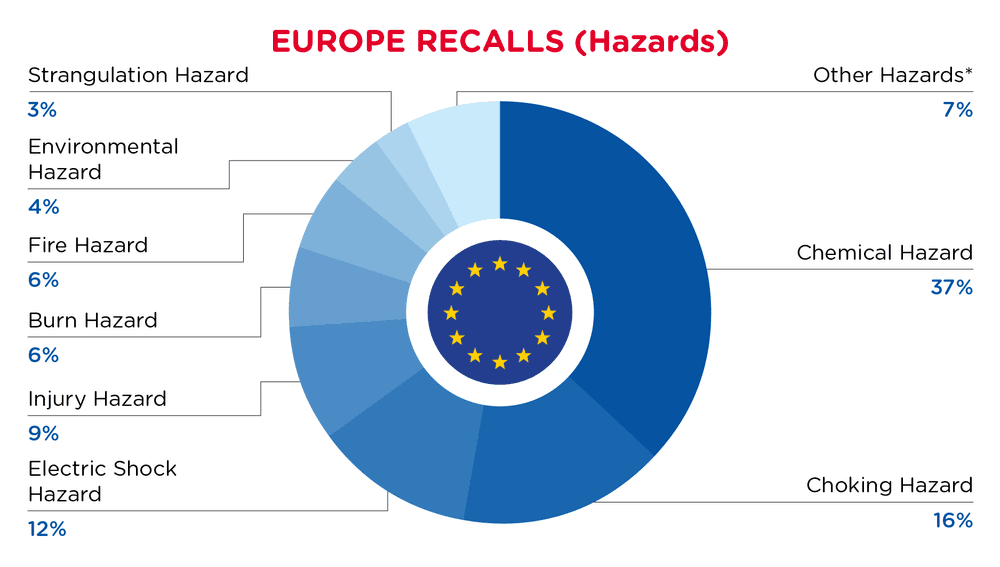
| Hazards | Frequency |
|---|---|
| Chemical Hazard | 176 |
| Choking Hazard | 74 |
| Electric Shock Hazard | 56 |
| Injury Hazard | 42 |
| Burn Hazard | 30 |
| Fire Hazard | 27 |
| Environmental Hazard | 18 |
| Strangulation Hazard | 14 |
| Other Hazards* | 33 |
*Other Hazards include Damage to Sight, Cut Hazard, Suffocation Hazard, Health Risk Hazard, Entrapment Hazard, Microbiological Hazard and Safety Risk Hazard with a frequency of less than 13.
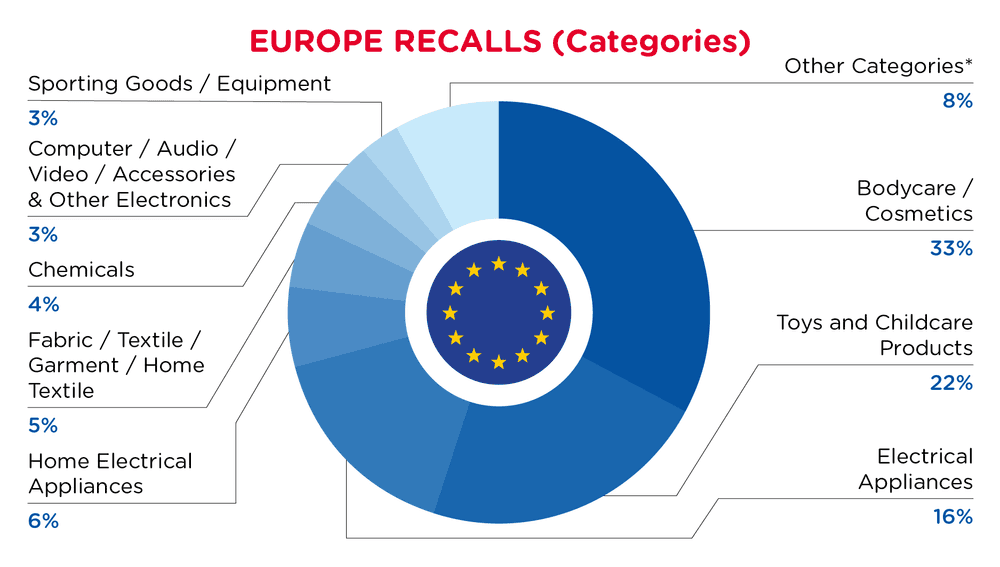
| Product Categories | Frequency |
|---|---|
| Bodycare / Cosmetics | 134 |
| Toys and Childcare Products | 88 |
| Electrical Appliances | 63 |
| Home Electrical Appliances | 26 |
| Fabric / Textile / Garment / Home Textile | 19 |
| Chemicals | 14 |
| Computer / Audio / Video / Other Electronics & Accessories | 12 |
| Sporting Goods / Equipment | 11 |
| Other Categories* | 33 |
*Other Categories include Machinery, Protective Equipment, Jewelry, Accessories, Footwear, Food Contact Material, Travel Items, Household Items and Car Accessories with a frequency of less than 10.
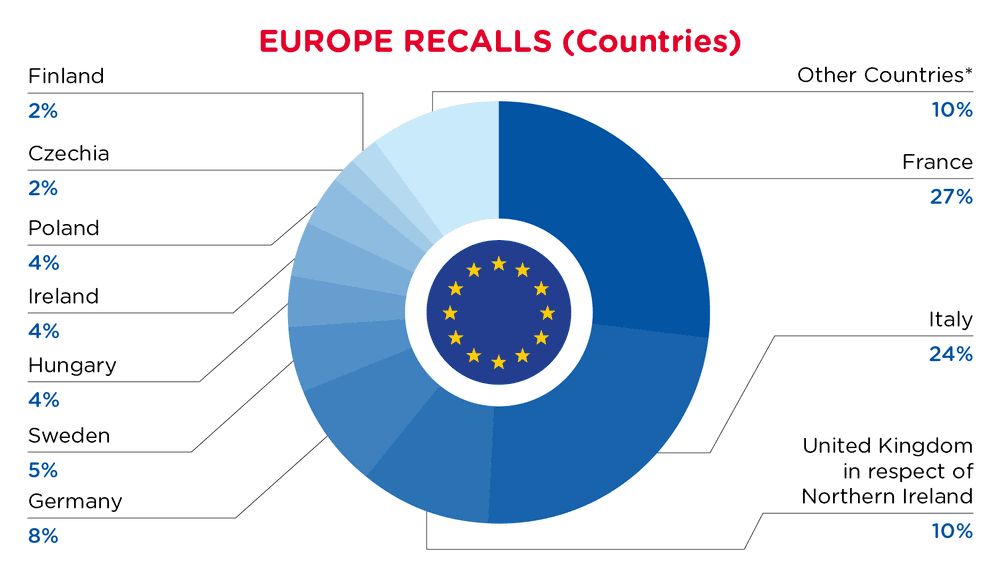
| Notifying Country | Frequency |
|---|---|
| France | 105 |
| Italy | 96 |
| United Kingdom in respect of Northern Ireland | 40 |
| Germany | 34 |
| Sweden | 19 |
| Hungary | 17 |
| Ireland | 16 |
| Poland | 15 |
| Czechia | 10 |
| Finland | 9 |
| Other Countries* | 39 |
*Other Countries include Spain, Denmark, Estonia, Lithuania, Slovenia, Slovakia, Austria, Malta, Greece, Iceland, Croatia, Cyprus and Norway with a frequency of less than 9.
For a complete list, click here.
Asia News
In China, when hazards are identified in consumer products, they will be recalled and published in the SAMR Defective Product Administrative Centre, which is updated daily. The China recalls from 01 June 2026 to 30 June 2026 are summarized below:
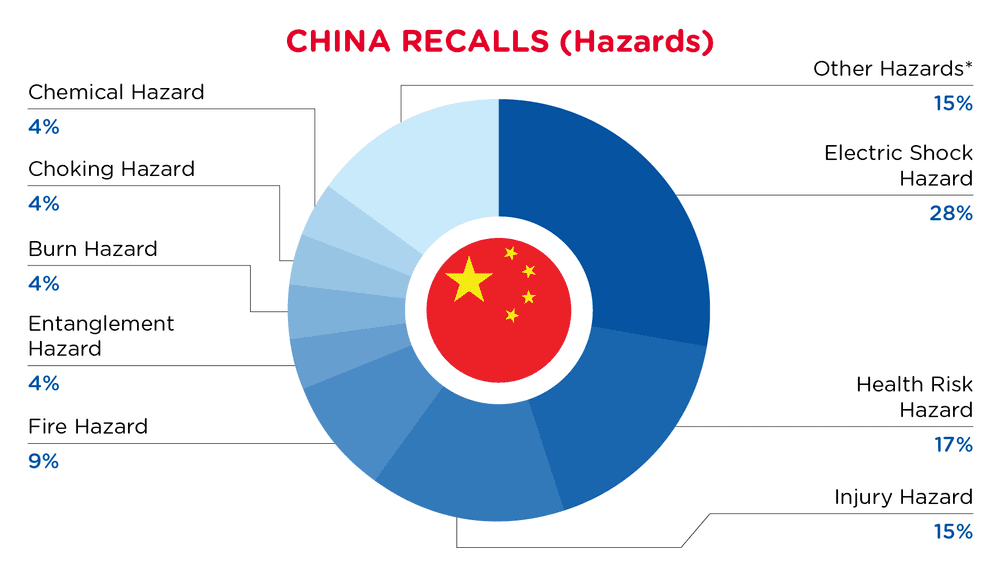
| Hazards | Frequency |
|---|---|
| Electric Shock Hazard | 13 |
| Health Risk Hazard | 8 |
| Injury Hazard | 7 |
| Fire Hazard | 4 |
| Entanglement Hazard | 2 |
| Burn Hazard | 2 |
| Choking Hazard | 2 |
| Chemical Hazard | 2 |
| Other Hazards* | 7 |
*Other Hazards include Skin Irritation Risk, Crash Hazard, Impact Hazard, Safety Risk Hazard, Carbon Monoxide Poisoning Hazard, Suffocation Hazard and Entrapment Hazard with a frequency of less than 2.
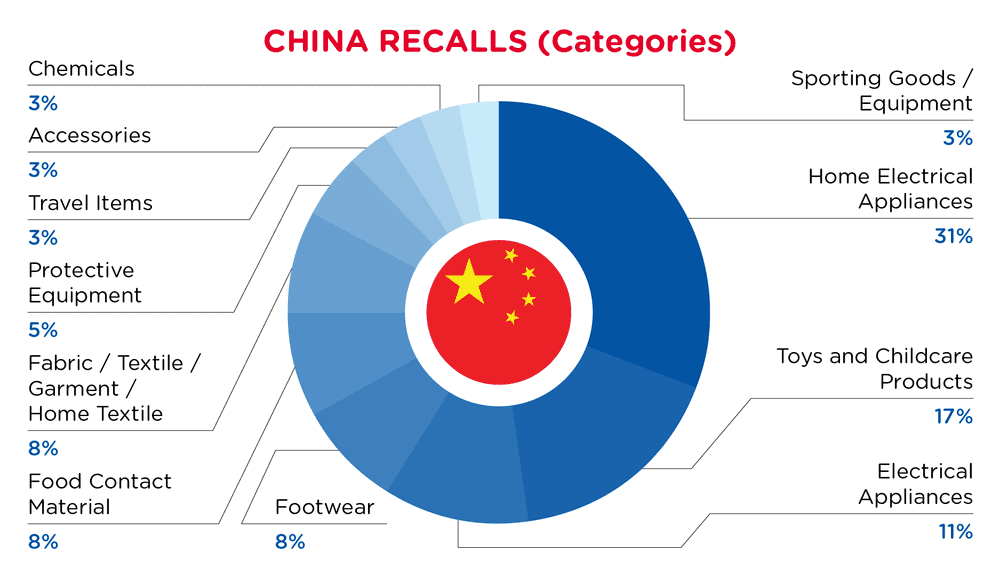
| Product Categories | Frequency |
|---|---|
| Home Electrical Appliances | 11 |
| Toys and Childcare Products | 6 |
| Electrical Appliances | 4 |
| Footwear | 3 |
| Food Contact Material | 3 |
| Fabric / Textile / Garment / Home Textile | 3 |
| Protective Equipment | 2 |
| Travel Items | 1 |
| Accessories | 1 |
| Chemicals | 1 |
| Sporting Goods / Equipment | 1 |
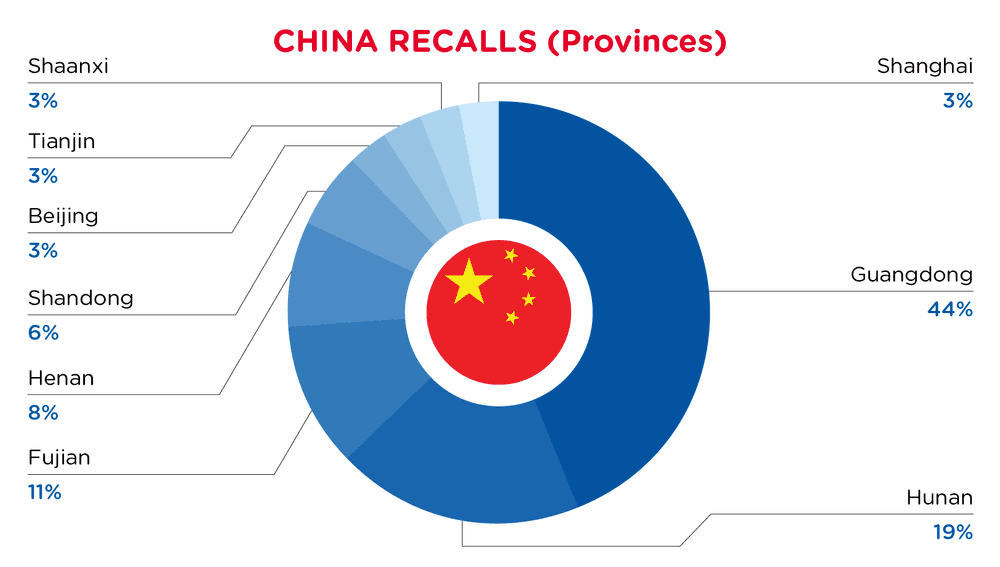
| Provinces | Frequency |
|---|---|
| Guangdong | 16 |
| Hunan | 7 |
| Fujian | 4 |
| Henan | 3 |
| Shandong | 2 |
| Beijing | 1 |
| Tianjin | 1 |
| Shaanxi | 1 |
| Shanghai | 1 |
For a complete list, click here.
Australia/New Zealand News
The new test standards AS 16321-1, AS 16321-2 and AS/NZS ISO 16321-3 have been published in 2026 for eye and face protectors.
Australian standards AS 16321-1, the standard for eye and face protection for occupational use, AS 16321-2, the occupational safety standard specifying safety and performance requirements for eye and face protectors used during welding and related techniques, and AS/NZS ISO 16321-3, a regional adaptation of the international standard specifying performance and marking requirements for mesh-style eye and face protectors have been published in 2026.
The requirements in the AS 16321 series have been aligned and modified according to the updated version of the EN ISO 16321 series which is the international benchmark standard for occupational and educational eye and face protection. These test standards replace AS/NZS 1337.1:2010, the standard that specifies the minimum requirements for non-prescription personal eye and face protectors and AS/NZS 1337.6:2012, the standard for prescription safety eyewear, both of which have been published for more than 10 years.
The new test standards summarized are:
AS 16321.1:2026 Eye and face protection for occupational use, Part 1: General requirements (ISO 16321-1:2021, MOD), published on 29 May 2026
AS 16321.2:2026 Eye and face protection for occupational use, Part 2: Additional requirements for protectors used during welding and related techniques (ISO 16321-2:2021, MOD), published on 29 May 2026
AS/NZS ISO 16321.3:2026 Eye and face protection for occupational use, Part 3: Additional requirements for mesh protectors, published on 19 June 2026
AS/NZS 1337.1:2010, AS/NZS 1337.6:2012 as well as reference standards AS/NZS 1338.1:2012, AS/NZS 1338.2:2012 and AS/NZS 1338.3:2012 will remain current for 36 months from the date of publication of this document. After this time, they will be superseded by the AS 16321 series. For reference:
AS/NZS 1338.1:2012 specifies the requirements for filters used in eye protectors to guard against high-intensity radiation generated during welding and allied operations
AS/NZS 1338.2:2012 specifies the requirements for filters used in eye protectors to guard against ultraviolet (UV) radiation
AS/NZS 1338.3:2012 (specifies the exact requirements for filters used in eye protectors designed to safeguard against infra-red (IR) radiation)
In Australia, when hazards are identified in consumer products, they will be recalled and published in the Recalls and Safety Alerts Database on the Australian Competition & Consumer Commission website, which is updated daily. The Australia recalls from 01 June 2026 to 30 June 2026 are summarized below:
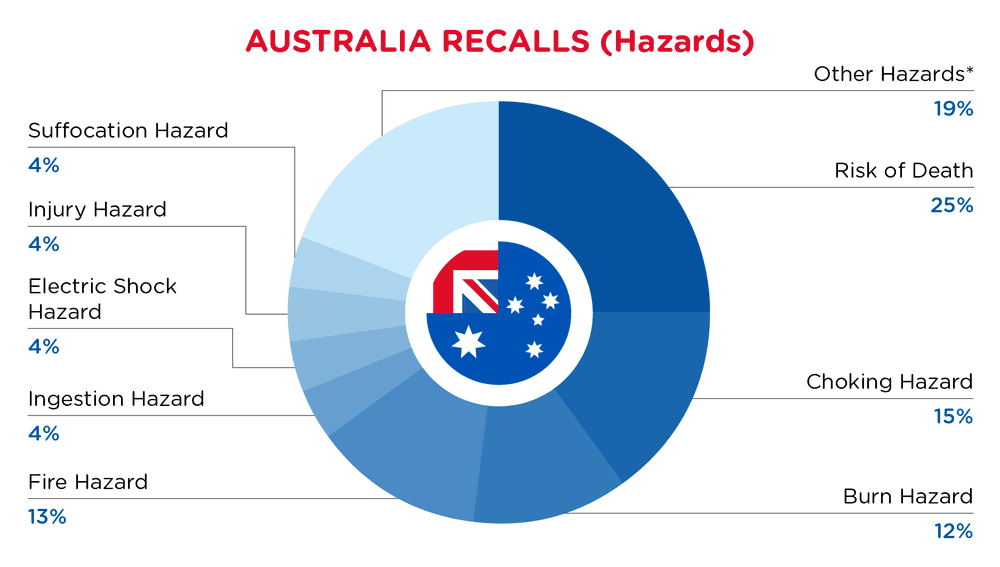
| Hazards | Frequency |
|---|---|
| Risk of Death | 12 |
| Choking Hazard | 7 |
| Burn Hazard | 6 |
| Fire Hazard | 6 |
| Ingestion Hazard | 2 |
| Electric Shock Hazard | 2 |
| Injury Hazard | 2 |
| Suffocation Hazard | 2 |
| Other Hazards* | 9 |
*Other Hazards include Aspiration Hazard, Damage to Sight, Health Risk Hazard, Drowning Hazard, Tip-Over Hazard, Crash Hazard, Impact Hazard, Laceration Hazard and Entrapment Hazard with a frequency of less than 2.
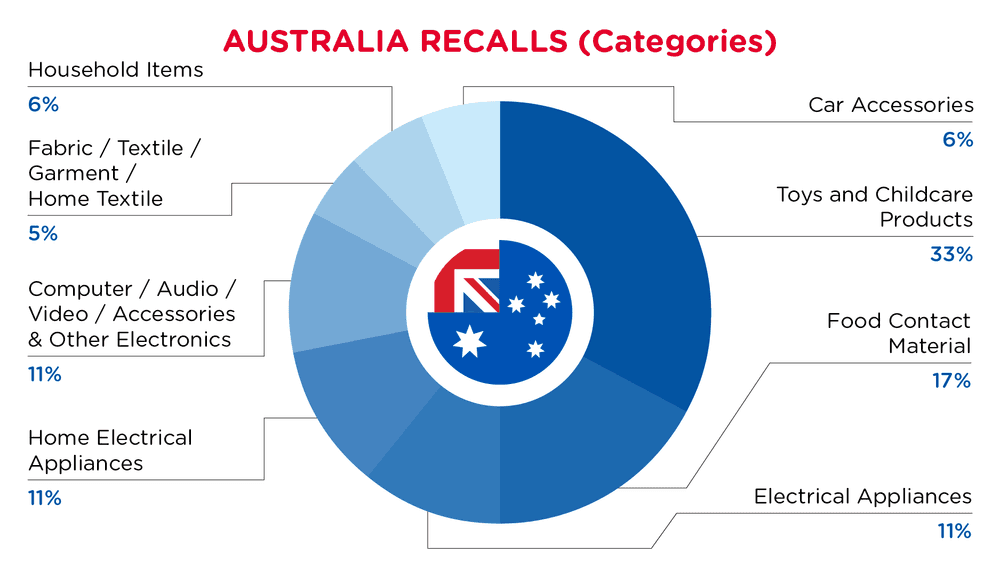
| Product Categories | Frequency |
|---|---|
| Toys and Childcare Products | 6 |
| Food Contact Material | 3 |
| Electrical Appliances | 2 |
| Home Electrical Appliances | 2 |
| Computer / Audio / Video / Other Electronics & Accessories | 2 |
| Fabric / Textile / Garment / Home Textile | 1 |
| Household Items | 1 |
| Car Accessories | 1 |
For a complete list, click here.
Subscribe to our Regulatory Updates
Unsubscribe at any time. Read our privacy policy.