February 2026

North America News
On 5 January 2026, Massachusetts House Bill 4870 was proposed to protect Massachusetts public health from PFAS. Applicable effective dates are outlined based on product category.
The state of Massachusetts proposed House Bill 4870 on 5 January 2026 to address concerns related to public health in relation to Per- and Polyfluoroalkyl substances (PFAS). Regarding the restrictions on consumer products, Bill 4870 sets the following timeline for banning intentionally added PFAS in several product categories:
| Product categories | Requirements | Effective date |
| Food Packaging | Prohibited intentionally added PFAS | 1 January 2028 |
| Priority Products: child passenger restraints, children’s products, cookware, fabric treatments, personal care products, rugs and carpets, textiles, textile furnishings, and upholstered furniture. | Prohibited intentionally added PFAS | 1 January 2029 |
Notes:
[1] The prohibition of intentionally added PFAS shall not apply to the sale of used products.[2] If the use of PFAS in consumer products is a currently unavoidable use, in consultation with the government, a temporary exemption at intervals of no more than 4 years can be granted.Washington State plans to update its law on lead in cookware by clarifying the scope and exemptions and extending the implementation date of the lead limit of 10 ppm.
The State of Washington proposed SB5975, a bill aimed at ensuring consumers have access to safe cookware. The bill would amend RCW 70A.565.010 and RCW 70A.565.020 regarding lead content limits in aluminum or brass cookware, utensils, and cookware components.
The key revisions are:
Modifies definitions and exemptions of aluminum or brass cookware/ aluminum or brass cookware components/ aluminum or brass utensils.
Extends the compliance date for the lead content restriction of 10 ppm as follows:
| Proposed action | Current action | |
| Target substance | Lead | Lead |
| Requirements | ≤ 90 ppm (1 January 2026) ≤ [1]10 ppm (1 January 2030) | ≤ 90 ppm (1 January 2026) ≤ 10 ppm (1 January 2028) |
Adds the definition of “Cookware testing methods” by introducing government accepted testing methods for evaluating the safety of aluminum or brass cookware utensils, or components including, but not limited to, methods published in the US Food and Drug Administration (FDA) elemental analysis manual, or methods described in the European Directorate for the Quality of Medicines & HealthCare (EDQM) technical guide for assessing metals and alloys in contact with food.
The bill would become effective 90 days after the end of the legislative session in which it is passed.
In the US, when hazards are identified in consumer products, they will be recalled and published in the Consumer Product Safety Commission (CPSC) Recent Recalls on the CPSC website, which is updated daily. The US recalls from 01 January 2026 to 31 January 2026 are summarized below:
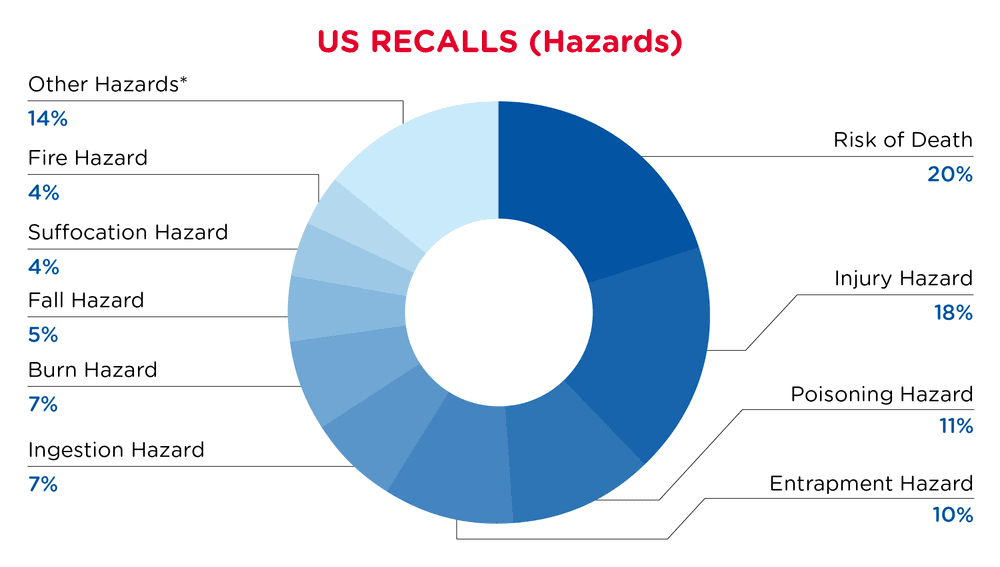
| Hazards | Frequency |
| Risk of Death | 19 |
| Injury Hazard | 18 |
| Poisoning Hazard | 11 |
| Entrapment Hazard | 10 |
| Ingestion Hazard | 7 |
| Burn Hazard | 7 |
| Fall Hazard | 5 |
| Suffocation Hazard | 4 |
| Fire Hazard | 4 |
| Other Hazards* | 14 |
*Other Hazards include Risk of Difficulty Breathing, Choking Hazard, Drowning Hazard, Tip-Over Hazard, Microbiological Hazard, Crash Hazard, Impact Hazard and Laceration Hazard with a frequency of less than 4.
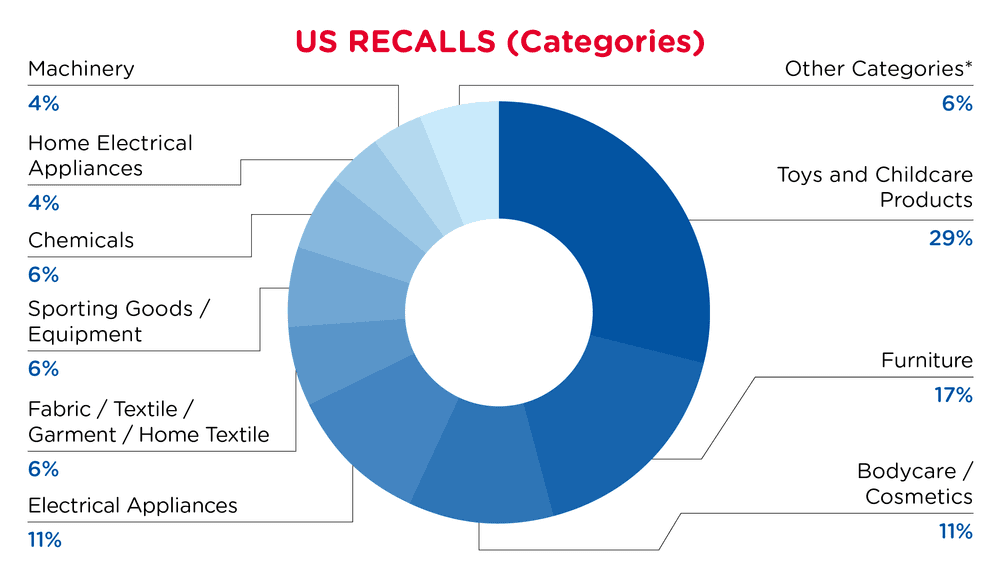
| Product Categories | Frequency |
| Toys and Childcare Products | 14 |
| Furniture | 8 |
| Bodycare / Cosmetics | 5 |
| Electrical Appliances | 5 |
| Fabric / Textile / Garment / Home Textile | 3 |
| Sporting Goods / Equipment | 3 |
| Chemicals | 3 |
| Home Electrical Appliances | 2 |
| Machinery | 2 |
| Other Categories* | 3 |
*Other Categories include Stationery, Protective Equipment and Outdoor Living Items with a frequency of less than 2.
For a complete list, click here
Published in the Canada Gazette, Part II, Volume 159, Number 27, on 31 December 2025, the Prohibition of Certain Toxic Substances Regulations, 2025 (SOR/2025-270) repeal and replace the 2012 Regulations. These regulations prohibit the manufacture, use, sale, and import of Dechlorane Plus (DP) and decabromodiphenyl ethane (DBDPE), and those products containing these substances. Additionally, they impose stricter controls on PFOS, PFOA, LC-PFCAs, HBCD, and PBDEs to reduce releases of these persistent, bioaccumulative substances into the environment.
On 31 December 2025, the Prohibition of Certain Toxic Substances Regulations, 2025 (SOR/2025/270) was published in the Canada Gazette, Part II, Volume 159, Number 27. These regulations repeal and replace the Canadian regulations from 2012.
1. Overview and Purpose
Enacted under the Canadian Environmental Protection Act, 1999 (CEPA), these regulations target toxic substances on Schedule 1 to CEPA, focusing on persistence and bioaccumulation risks with the intent to reduce the presence of these harmful substances in the Canadian environment.
2. Prohibitions
A person must not manufacture, use, sell, or import prohibited substances listed in Schedule 1 or products containing them, except where incidentally present below thresholds or exempted/authorized.
3. Key Substances and Updates
New prohibitions on: Flame retardants Dechlorane Plus (DP) and decabromodiphenyl ethane (DBDPE)
Enhanced restrictions on:
PFOS, PFOA, LC-PFCAs (repeal of exemptions for personal imports, certain Aqueous Film Forming Foam (AFFF) uses phased out)
HBCD and PBDEs (including decaBDE; broader coverage, time-limited exemptions for legacy products)
4. Exemptions and Incidental Presence
Time-limited exemptions for essential uses: e.g., aerospace, defence, vehicles, electronics; DBDPE up to ~15 years; HBCD vehicle parts to 2031; AFFF to 2027–2030
Exemptions for laboratory/research (reporting if >10 g/year for DP/DBDPE) and items in transit through Canada
Incidental presence thresholds: e.g., HBCD ≤100 mg/kg; PBDEs ≤1,000 mg/kg in electrical/electronic equipment
5. Permits and Compliance Requirements
Temporary permits (up to 3 years, renewable) available for specific non-exempt activities
Analyses by accredited laboratories; records kept for 5 years
6. Entry into Force and Application
Enters into force: 30 June 2026 (repeals 2012 Regulations on same date)
In Canada, when hazards are identified in consumer products, they will be recalled and published in the Recalls and Safety Alerts Database on the Health Canada website, which is updated daily. The Canada recalls from 01 January 2026 to 31 January 2026 are summarized below:
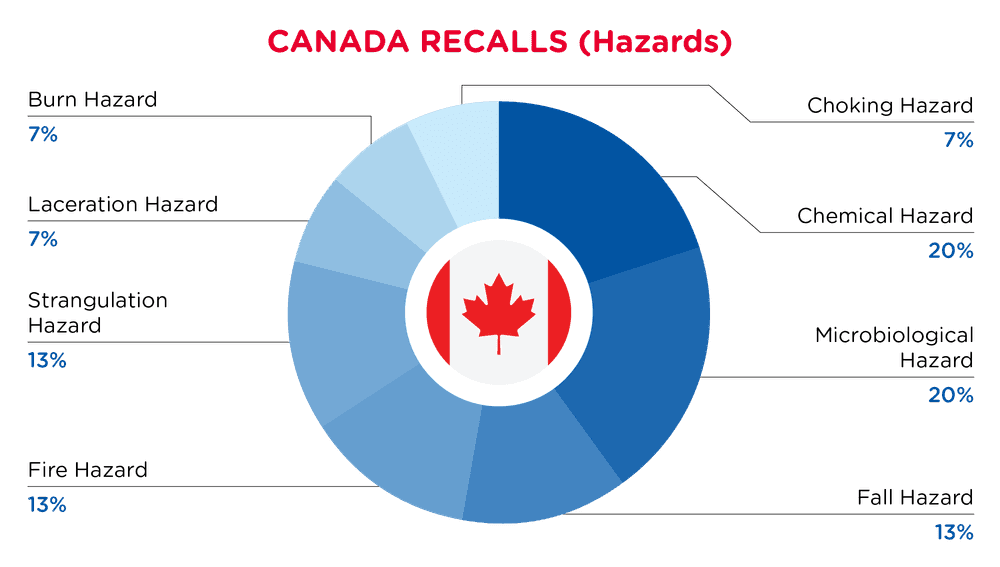
| Hazards | Frequency |
| Chemical Hazard | 3 |
| Microbiological Hazard | 3 |
| Fall Hazard | 2 |
| Fire Hazard | 2 |
| Strangulation Hazard | 2 |
| Laceration Hazard | 1 |
| Burn Hazard | 1 |
| Choking Hazard | 1 |
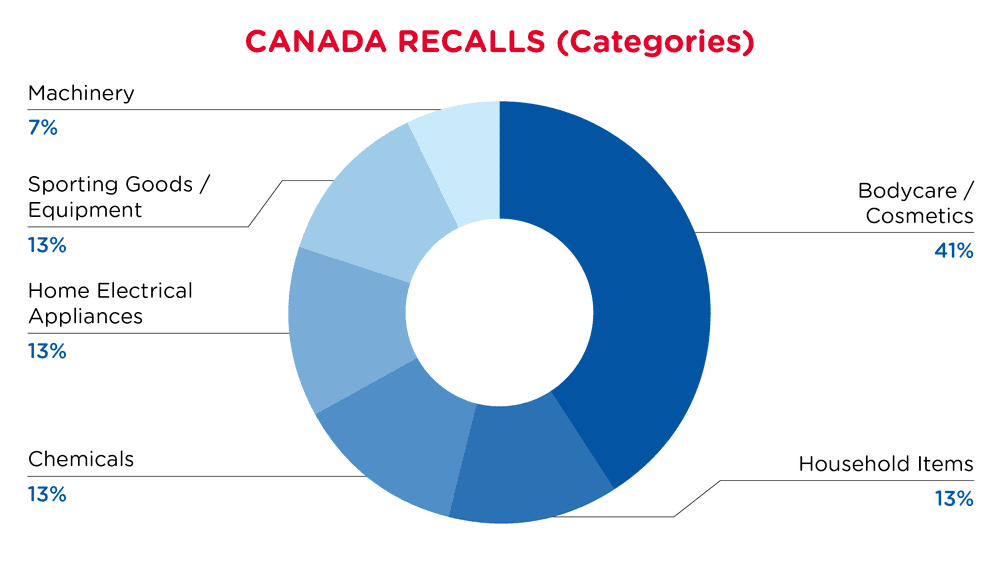
| Product Categories | Frequency |
| Bodycare / Cosmetics | 6 |
| Household Items | 2 |
| Chemicals | 2 |
| Home Electrical Appliances | 2 |
| Sporting Goods / Equipment | 2 |
| Machinery | 1 |
For a complete list, click here
Europe News
The European Commission adopted Directive (EU) 2026/192 on 28 January 2026, amending Appendix A of Annex II to Directive 2009/48/EC on toy safety. The Directive permits the use of cobalt—a carcinogenic, mutagenic, and toxic for reproduction (CMR) category 1B substance—in specific toy applications where the Scientific Committee on Health, Environmental and Emerging Risks (SCHEER) has determined safe use conditions. This regulatory amendment establishes derogations from the general prohibition on CMR substances in toys for stainless steel toy components, electrical conductors, and certain neodymium-based magnets, effective 29 August 2026. It also bridges the gap toward the upcoming Toy Safety Regulation (EU) 2025/2509.
Cobalt (in metallic form and as various salts) is classified as carcinogenic category 1B, mutagenic category 2, and toxic for reproduction category 1B under European Union (EU) chemical classification rules. The EU Toy Safety Directive generally prohibits such hazardous substances in toys to protect children. Cobalt appears in toys in two ways:
As an unintended impurity in nickel-containing materials (stainless steel, nickel plating, electroconductive coatings)
As an intentionally added substance (pigments, colorants, batteries, 3D printing materials)
The EU's Scientific Committee on Health, Environmental and Emerging Risks (SCHEER) evaluated cobalt safety in toys through a December 2022 opinion. SCHEER examined six scenarios covering different toy types and exposure routes (inhalation, skin contact, ingestion). SCHEER identified three safe applications.
On 28 January 2026, the European Commission adopted Directive (EU) 2026/192, to restrict cobalt in toys. This update amends Appendix A of Annex II to Directive 2009/48/EC on toy safety and limits the use of cobalt to specific safe applications, serving as a critical bridge to the comprehensive new Toy Safety Regulation (EU) 2025/2509.
1. Key Changes
Added the following in Appendix A of Annex II to Directive 2009/48/EC
| Substance | Classification | Permitted Use |
| Cobalt | CMR 1B | In toys and toy components made of stainless steel, as an impurity in the nickel contained in the stainless steel In toy components which are intended to conduct electric current. In neodymium-based magnets used in toys, if those magnets cannot be swallowed or inhaled |
This update is part of a broader shift toward the Toy Safety Regulation (EU) 2025/2509 which entered into force on 1 January 2026 with a full transition ending in 2030.
2. Implementation and Resources
Member States must transpose these rules into national laws by 29 July 2026. These provisions must be officially applied starting from 29 August 2026.
ECHA announced that on 4 February 2026, n-hexane and 4,4'-[2,2,2-trifluoro-1-(trifluoromethyl)ethylidene]diphenol and its salts were included as members of the SVHC Candidate List.
On 1 September 2025, the European Chemical Agency (ECHA) launched a 45-days public consultation on 4,4'-dihydroxydiphenylmethane (Bisphenol F, BPF), n-hexane and 4,4'-[2,2,2-trifluoro-1-(trifluoromethyl)ethylidene]diphenol and its salts, as potential Substances of Very High Concern (SVHC).
After further discussion within ECHA’s Member State Committee, two substances were concluded to be members of the SVHC Candidate List (Candidate List). (The proposal for recognizing 4,4'-dihydroxydiphenylmethane (Bisphenol F, BPF) as an SVHC was withdrawn before the meeting, but the SVHC process for this substance is still ongoing.)
Based on the above conclusion in ECHA’s Member State Committee, ECHA officially added two substances to the Candidate List on 4 February 2026.
The number of SVHCs on the Candidate List is now updated to 253 entries.
Details of the new SVHC chemicals added to the Candidate List are summarized in the below tables.
The New SVHCs:
| Substance name | EC number | CAS number | Reason for inclusion | Examples of use |
| n-hexane | 203-777-6 | 110-54-3 | Specific target organ toxicity after repeated exposure [Article 57(f) - human health] | Formulation Polymer processing Coatings Cleaning agent |
| 4,4'-[2,2,2-trifluoro-1-(trifluoromethyl)ethylidene]diphenol and its salts | - | - | Toxic for reproduction [Article 57(c)] | Process regulator Cross-linking agent |
Manufacturers and importers should take note of this new SVHC and potential and current use in their processes or products to plan accordingly.
The European Commission has officially issued (EU) 2026/250 to correct the terminology, scope and deadlines for the use of Bisphenols as outlined in Regulation (EU) 2024/3190. Regulation, (EU) 2026/245 updating the positive list of substances for food contact plastics was also issued to amend Annex I to (EU) 10/2011 on plastic materials and articles intended to come into contact with food.
On 2 February 2026, the European Union (EU) Commission released (EU) 2026/250 to revise Commission Regulation (EU) 2024/3190 on the use of bisphenol A (BPA) in food contact materials (FCM) and products. This revision clarifies certain inconsistences and errors related to terminology, scope and deadlines. These corrections are important to ensure the accurate application of the Regulation.
The following table can be helpful to quickly review the revisions:
Table 1- Revisions of Commission Regulation (EU) 2024/3190
| Applicable Article of (EU) 2024/3190 | Revisions in (EU) 2026/250 | Note |
| Article 3 Prohibition of the use of BPA | 1. The use of BPA in the manufacture of food contact materials and articles……, is prohibited 2. By way of derogation from paragraph 1, BPA may be used in the manufacture of food contact materials…… | In Article 3 of Regulation (EU) 2024/3190, the reference to ‘BPA and its salts’ is inconsistent with the definition of ‘bisphenol’ laid down in Article 2(2)(c) of that Regulation. Therefore, the words ‘and its salts’ should be deleted from Article 3. |
| Article 9 Verification of compliance with the requirements of this Regulation | 2. For the selection of methods used to verify that a food contact material or article does not contain residual BPA, another hazardous bisphenol or a hazardous bisphenol derivative…… (c) to verify that a food contact material or article does not contain residual BPA, another hazardous bisphenol or a hazardous bisphenol derivative, an extraction method shall be used.’ | Article 9(2) of Regulation (EU) 2024/3190 aims to ensure that an appropriate method of analysis is used to determine compliance with Article 4 of that Regulation. Since Article 4 prohibits the presence of ‘residual BPA’, Article 9(2)(c) of that Regulation should also refer to ‘residual BPA’. |
| Article 11 Transitional provisions concerning single-use final food contact articles | 1. Single-use final food contact articles manufactured using BPA and complying with the rules as applicable before the date of entry into force of this Regulation, which do not comply with the rules in this Regulation, may be first placed on the market until 20 July 2026. 2. By way of derogation from paragraph 1…… which do not comply with the rules in this Regulation, may be first placed on the market until 20 January 2028 | Article 11 of that Regulation aims to provide transitional provisions for the first placing on the market of single-use final food contact articles. Since Article 11 mistakenly refers only to food contact materials ‘placed on the market’, it should be corrected. |
| Article 12 Transitional provisions concerning repeat-use final food contact articles | 3. Repeat-use final food contact articles that were first placed on the market in accordance with paragraphs 1 may remain on the market until 20 July 2027. Repeat use final food contact articles that were first placed on the market in accordance with paragraph 2 may remain on the market until 20 January 2029 | The end of the transitional period for food contact articles in paragraph 1 is different from the end of the transitional period for food contact articles in paragraph 2, the indicated date of 20 January 2029 only applies to articles first placed on the market in accordance with paragraph 2. |
| ANNEX III The declaration of compliance referred to in Article 8 shall contain the following information | (3) the identity of intermediate food contact materials or final food contact articles; | The aim is to require the identity of food contact materials and articles from one business to another. Therefore, the wording should be corrected. |
Additionally, regulation (EU) 2026/245, updating the positive list of substances for food contact plastics, has been issued to amend Annex I to Regulation (EU) No 10/2011 on plastic materials and articles intended to come into contact with food as follows:
Table 1 (positive list)
Entry 768: Chemical name and the restrictions and specifications have been updated
Entry 1084, 1089, 1092, 1093, 1094 and 1096 have been added
Table 3 (Notes on verification of compliance)
Entry 31 has been added as, “Water shall be used for verification of compliance instead of food simulants listed in Table 1 of Annex III.”
These amendments shall enter into force on 23 February 2026.
Manufacturers shall pay attention to the manufacturing and storage, to ensure they meet the updated requirements.
The French government introduced strict limits for PFAS by implementing new Decree No. 2025-1376 of 28 December 2025.
On 30 December 2025, the French government issued new Decree No. 2025-1376 of 28 December 2025 to ban Per- and Polyfluoroalkyl substances (PFAS) in certain consumer products. The new law is the implementation of the framework of Law No. 2025-188 of 27 February 2025 on the protection of the population from the risks associated with PFAS.
Main contents of Decree No. 2025-1376:
1. Restrictions
The following three limits shall be applied concurrently for PFAS compliance:
Any individual PFAS (excluding polymers): 25 ppb
The sum of PFAS (with prior degradation of precursors, excluding polymers): 250 ppb
Total fluorine content (including polymers): 50 ppm*
*If the total fluoride content exceeds 50 mg F/kg, evidence needs to be provided supporting that the fluoride content is derived from PFAS or from non-PFAS substances at the request of the competent authorities.
2. Scope of regulated products and effective date
1. The restrictions apply to certain products from 1 January 2026:
Cosmetics
Wax
Textile products
Footwear
Waterproofing agents
2. The restrictions apply to any textile product containing PFAS from 1 January 2030.
3. Exceptions
Technical textiles for industrial use
Personal Protective Equipment (PPE) covered by Regulation (EU) 2016/425 or for the armed forces, internal security and civil security
Clothing and footwear textiles incorporating at least 20% recycled material from post-consumer waste
Interested parties shall carry out an accurate inventory of the presence of PFAS in their products, raw materials and manufacturing processes and keep in mind the key dates in 2026 and 2030 to implement changes on time.
In Europe, when hazards are identified in non-food consumer products, the products will be recalled and published in the Safety Gate system, which is updated weekly. The European recalls from 01 January 2026 to 31 January 2026 are summarized below:
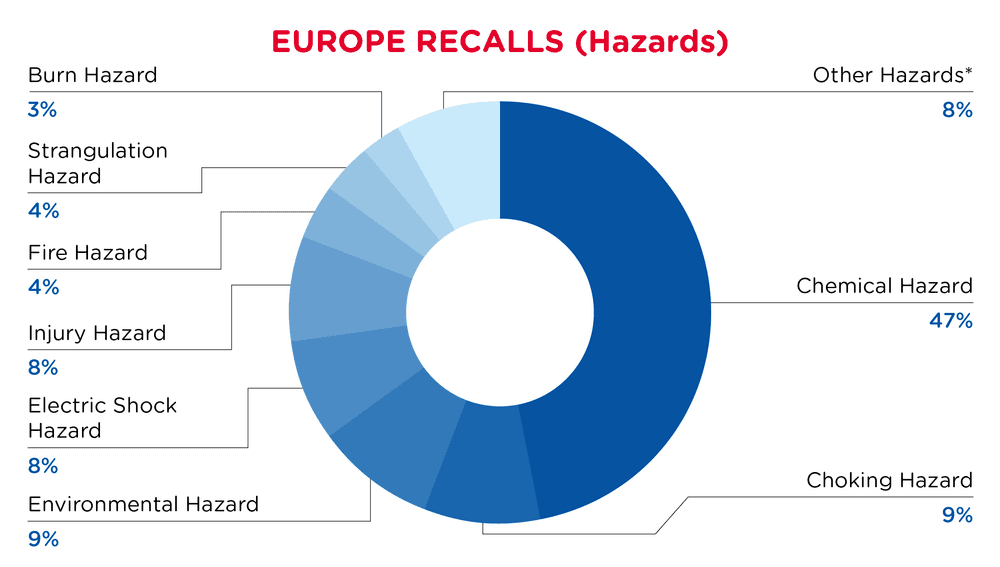
| Hazards | Frequency |
| Chemical Hazard | 144 |
| Choking Hazard | 29 |
| Environmental Hazard | 29 |
| Electric Shock Hazard | 25 |
| Injury Hazard | 23 |
| Fire Hazard | 13 |
| Strangulation Hazard | 12 |
| Burn Hazard | 8 |
| Other Hazards* | 25 |
*Other Hazards include Damage to Sight, Microbiological Hazard, Drowning Hazard, Damage to Hearing, Suffocation Hazard, Cut Hazard, Health Risk Hazard and Entrapment Hazard with a frequency of less than 8.
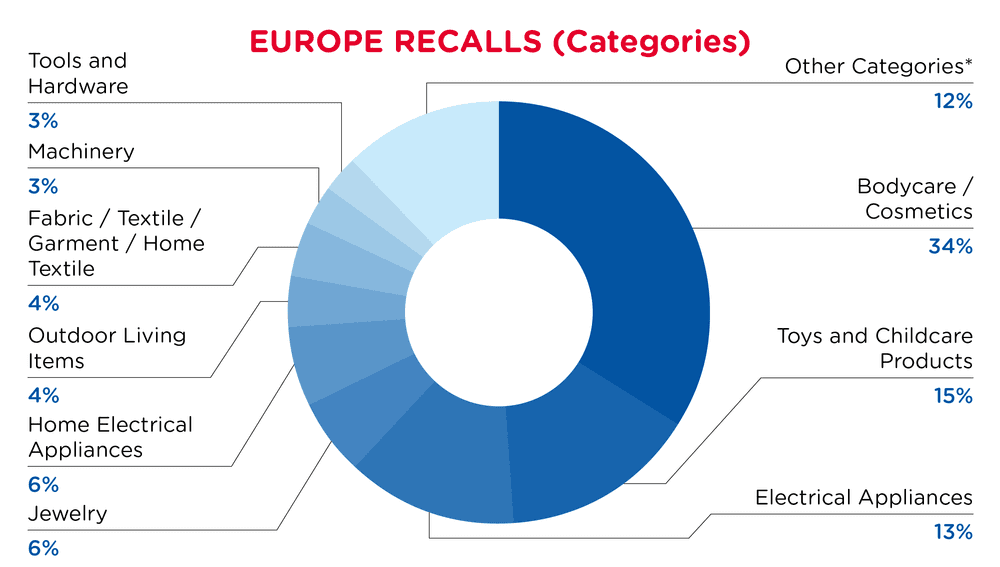
| Product Categories | Frequency |
| Bodycare / Cosmetics | 93 |
| Toys and Childcare Products | 40 |
| Electrical Appliances | 36 |
| Jewelry | 17 |
| Home Electrical Appliances | 15 |
| Outdoor Living Items | 12 |
| Fabric / Textile / Garment / Home Textile | 11 |
| Machinery | 8 |
| Tools and Hardware | 7 |
| Other Categories* | 31 |
*Other Categories include Car Accessories, Sporting Goods / Equipment, Accessories, Household Items, Chemicals, Furniture, Stationery, Footwear, Protective Equipment and Food Contact Material with a frequency of less than 7.
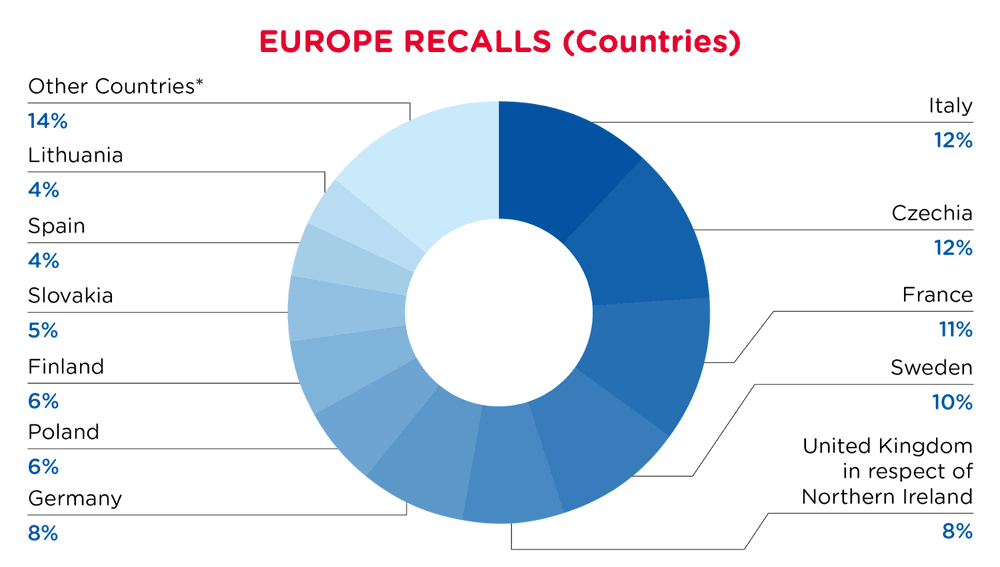
| Notifying Country | Frequency |
| Italy | 34 |
| Czechia | 32 |
| France | 31 |
| Sweden | 26 |
| United Kingdom in respect of Northern Ireland | 22 |
| Germany | 21 |
| Poland | 16 |
| Finland | 16 |
| Slovakia | 14 |
| Spain | 10 |
| Lithuania | 10 |
| Other Countries* | 38 |
*Other Countries include Belgium, Denmark, Estonia, Norway, Cyprus, Slovenia, Ireland, Austria and Bulgaria with a frequency of less than 10.
For a complete list, click here
China News
In China, when hazards are identified in consumer products, they will be recalled and published in the SAMR Defective Product Administrative Centre, which is updated daily. The China recalls from 01 January 2026 to 31 January 2026 are summarized below:
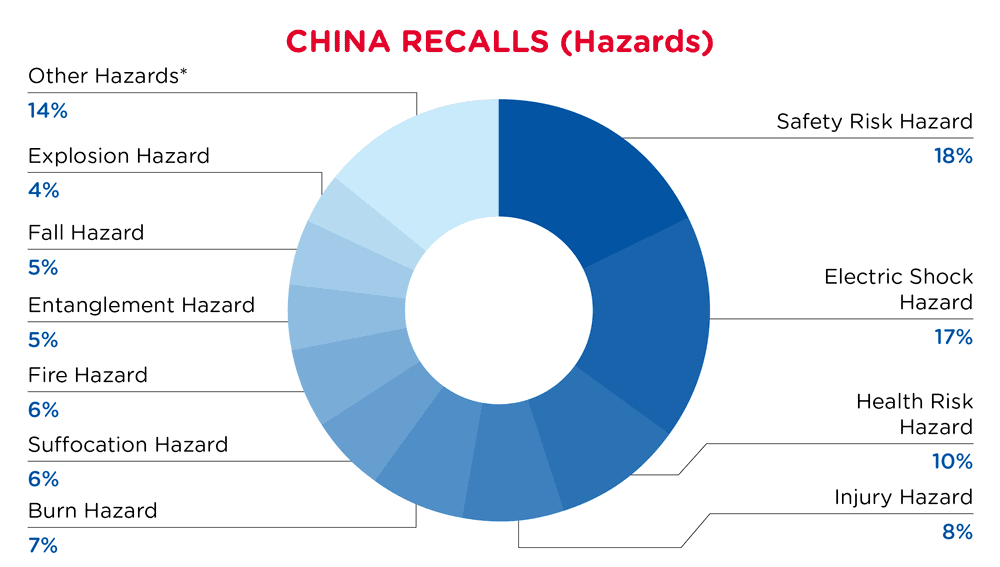
| Hazards | Frequency |
| Safety Risk Hazard | 15 |
| Electric Shock Hazard | 14 |
| Health Risk Hazard | 8 |
| Injury Hazard | 7 |
| Burn Hazard | 6 |
| Suffocation Hazard | 5 |
| Fire Hazard | 5 |
| Entanglement Hazard | 4 |
| Fall Hazard | 4 |
| Explosion Hazard | 3 |
| Other Hazards* | 12 |
*Other Hazards include Damage to Skin, Impact Hazard, Puncture Hazard, Crash Hazard, Skin Irritation Risk, Damage to Sight, Microbiological Hazard, Ingestion Hazard and Swallowing Risk with a frequency of less than 3.
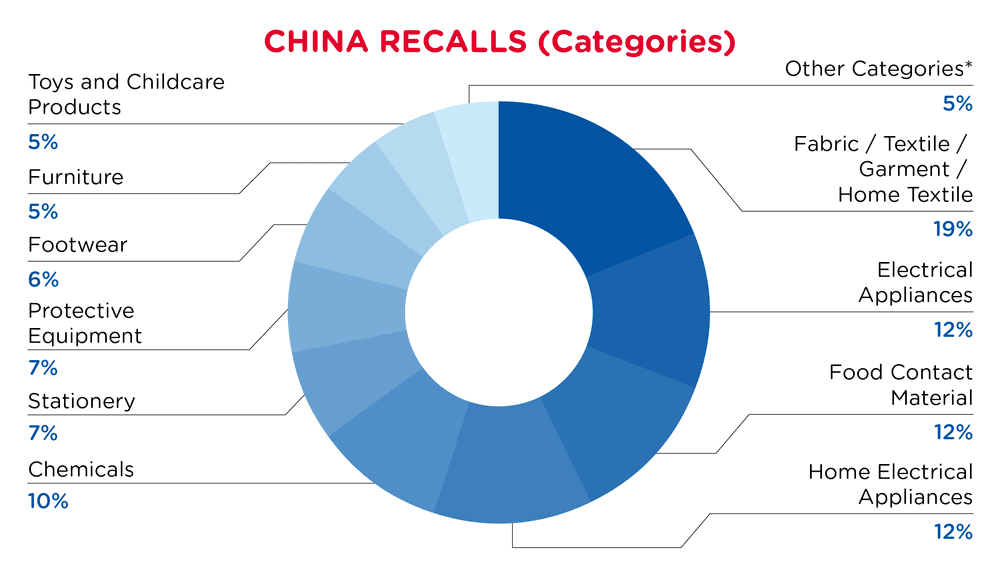
| Product Categories | Frequency |
| Fabric / Textile / Garment / Home Textile | 14 |
| Electrical Appliances | 9 |
| Food Contact Material | 9 |
| Home Electrical Appliances | 9 |
| Chemicals | 7 |
| Stationery | 5 |
| Protective Equipment | 5 |
| Footwear | 4 |
| Furniture | 4 |
| Toys and Childcare Products | 4 |
| Other Categories* | 4 |
*Other Categories include Bodycare / Cosmetics, Sporting Goods / Equipment and Accessories with a frequency of less than 4.
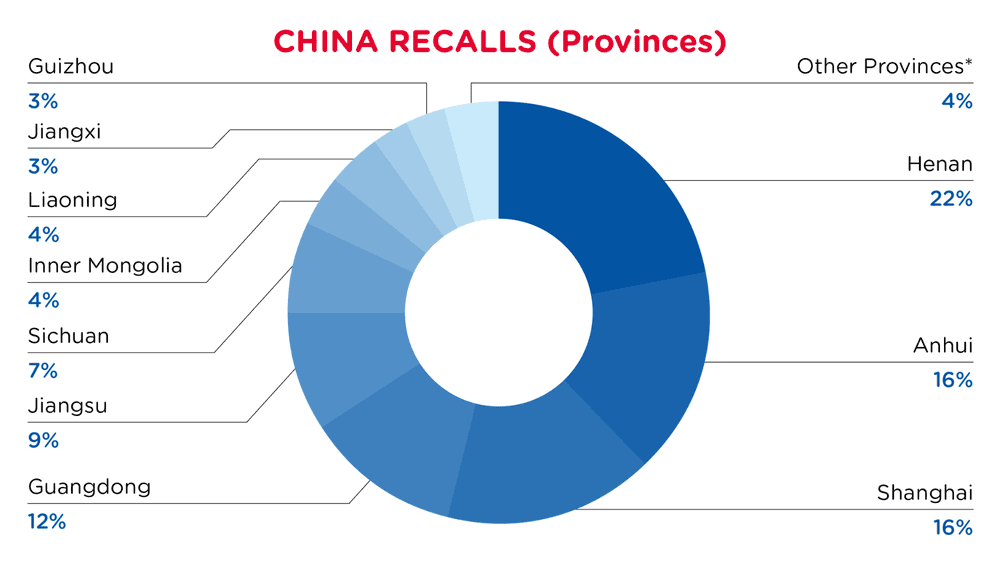
| Provinces | Frequency |
| Henan | 16 |
| Anhui | 12 |
| Shanghai | 12 |
| Guangdong | 9 |
| Jiangsu | 7 |
| Sichuan | 5 |
| Inner Mongolia | 3 |
| Liaoning | 3 |
| Jiangxi | 2 |
| Guizhou | 2 |
| Other Provinces* | 3 |
*Other Provinces include Beijing, Hubei and Shaanxi with a frequency of less than 2.
For a complete list, click here
Australia/New Zealand News
In Australia, when hazards are identified in consumer products, they will be recalled and published in the Recalls and Safety Alerts Database on the Australian Competition & Consumer Commission website, which is updated daily. The Australia recalls from 01 January 2026 to 31 January 2026 are summarized below:
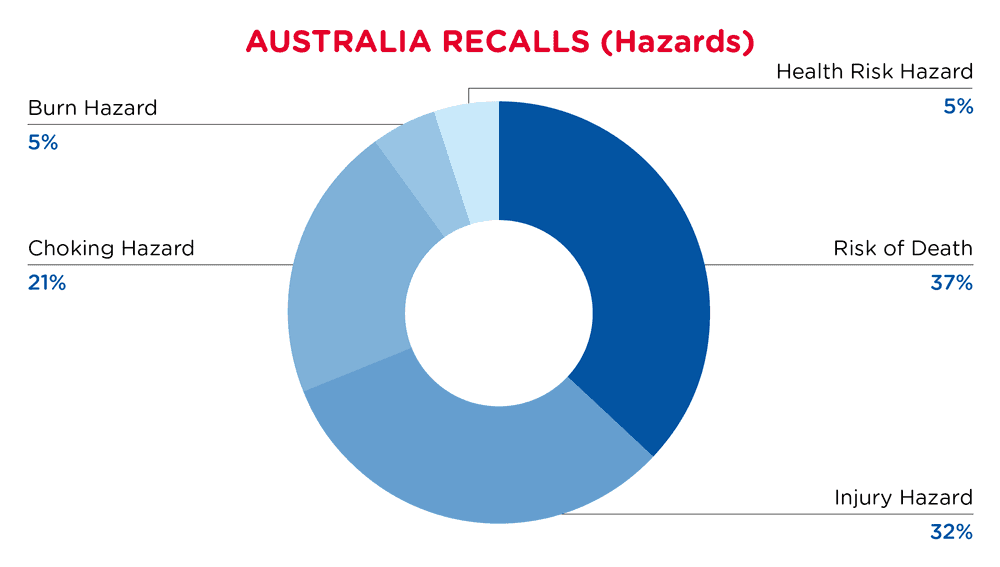
| Hazards | Frequency |
| Risk of Death | 19 |
| Injury Hazard | 17 |
| Choking Hazard | 11 |
| Burn Hazard | 3 |
| Health Risk Hazard | 3 |
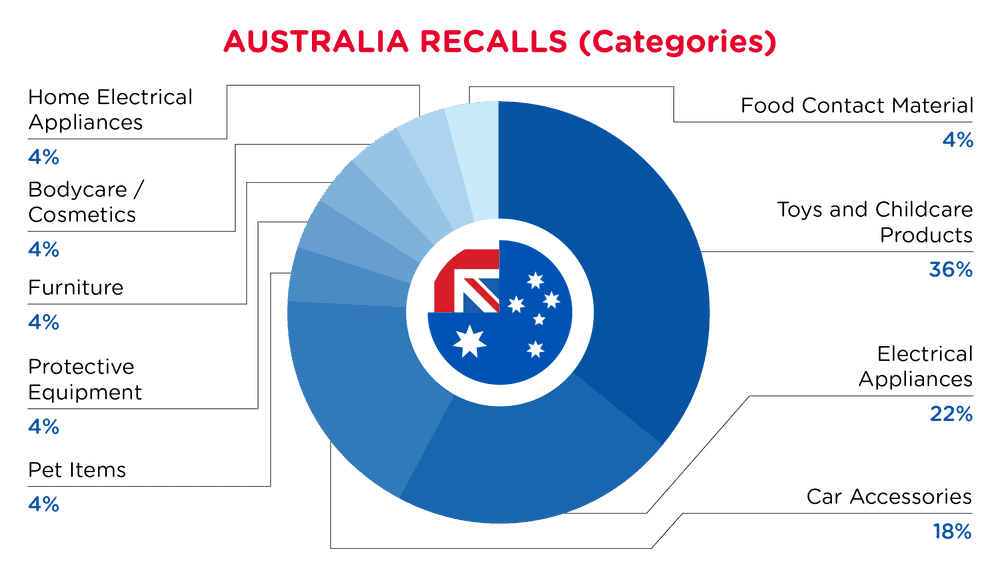
| Product Categories | Frequency |
| Toys and Childcare Products | 8 |
| Electrical Appliances | 5 |
| Car Accessories | 4 |
| Pet Items | 1 |
| Protective Equipment | 1 |
| Furniture | 1 |
| Bodycare / Cosmetics | 1 |
| Home Electrical Appliances | 1 |
| Food Contact Material | 1 |
For a complete list, click here
Subscribe to our Regulatory Updates
Unsubscribe at any time. Read our privacy policy.