November 2025

North America News
In the US, when hazards are identified in consumer products, they will be recalled and published in the Consumer Product Safety Commission (CPSC) Recent Recalls on the CPSC website, which is updated daily. The US recalls from 01 October 2025 to 31 October 2025 are summarized below:
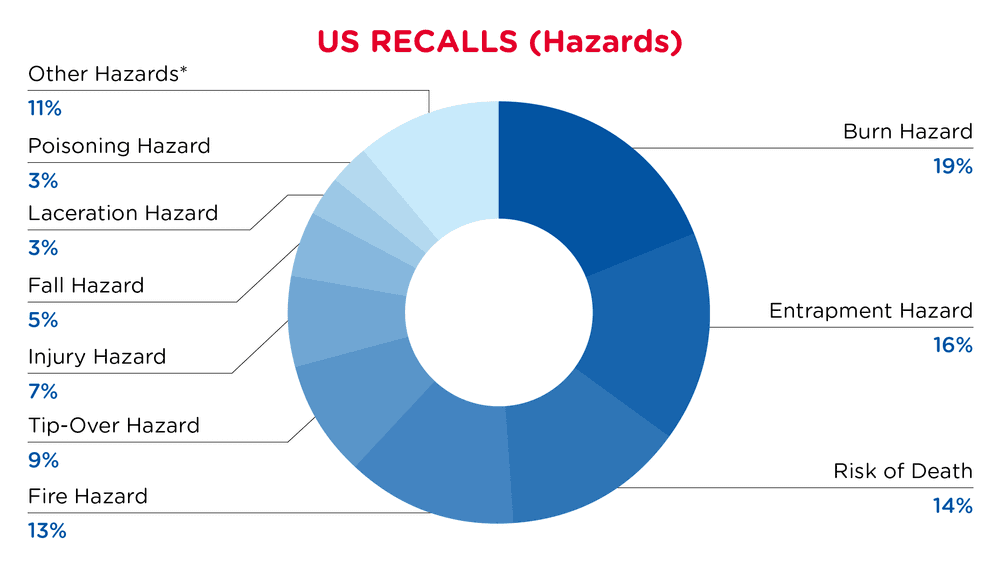
| Hazards | Frequency |
| Burn Hazard | 14 |
| Entrapment Hazard | 12 |
| Risk of Death | 11 |
| Fire Hazard | 10 |
| Tip-Over Hazard | 7 |
| Injury Hazard | 5 |
| Fall Hazard | 4 |
| Laceration Hazard | 2 |
| Poisoning Hazard | 2 |
| Other Hazards* | 8 |
*Other Hazards include Skin Irritation Risk, Carbon Monoxide Poisoning Hazard, Lead Poisoning Hazard, Drowning Hazard, Ingestion Hazard, Suffocation Hazard, Aspiration Hazard and Strangulation Hazard with a frequency of less than 2.
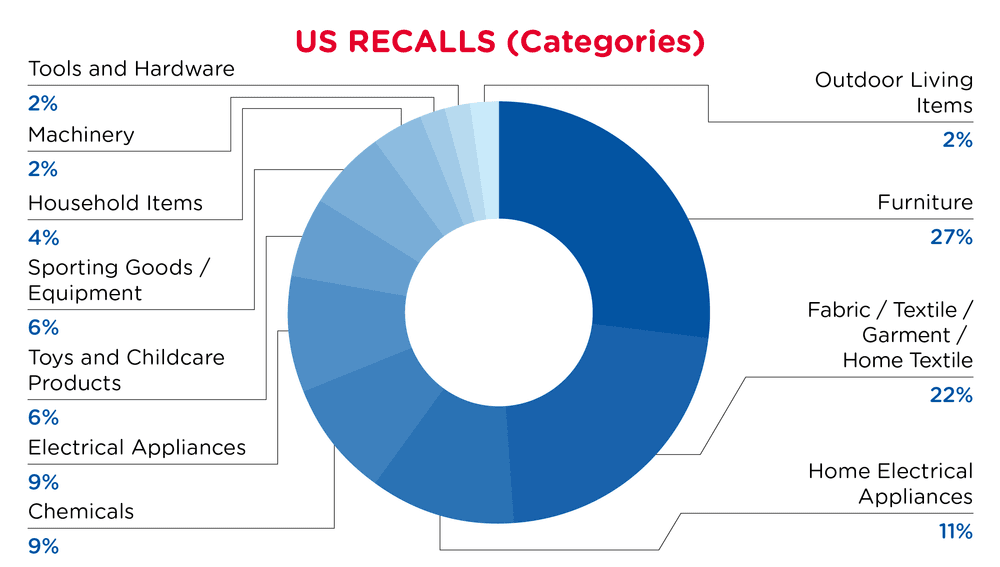
| Product Categories | Frequency |
| Furniture | 12 |
| Fabric / Textile / Garment / Home Textile | 10 |
| Home Electrical Appliances | 5 |
| Chemicals | 4 |
| Electrical Appliances | 4 |
| Toys and Childcare Products | 3 |
| Sporting Goods / Equipment | 3 |
| Household Items | 2 |
| Machinery | 1 |
| Tools and Hardware | 1 |
| Outdoor Living Items | 1 |
For a complete list, click here
1. Dissolution of the IFT
On October 17, the government officially replaced the Federal Telecommunications Institute (IFT) with the Telecommunications Regulatory Commission (CRT), as a result of the new Telecommunications and Broadcasting Law.
The new CRT agency has assumed responsibility for supervising the radioelectric spectrum, as well as issuing and enforcing regulatory requirements for devices that use the radioelectric spectrum or can be connected to a telecommunications network.
The CRT began operations on October 21, and homologation activities resumed on October 27.
2. New Technical Requirements in Mexico
IFT-012-2023 – Effective November 7
Applicable to the following frequency bands and technologies:
5150–5250 MHz
5250–5350 MHz
5470–5600 MHz
5650–5725 MHz
5725–5850 MHz
5925–6425 MHz
Technologies: IEEE 802.11 a/c/ac/ax / WiFi 5GHz, WiFi 6, WiFi 6E
IFT-016-2024 – Effective November 6
Applicable to:
Low Power Radiocommunication
Frequency range: 30 MHz – 3 GHz
Note: This regulation does not impact the scope of NOM-208-SCFI-2016 (IFT-008-2015).
NYCE Capability: For both regulations, NYCE is already accredited as a Certification Body, and we have a third-party laboratory ready to perform the required testing.
In Canada, when hazards are identified in consumer products, they will be recalled and published in the Recalls and Safety Alerts Database on the Health Canada website, which is updated daily. The Canada recalls from 01 October 2025 to 31 October 2025 are summarized below:
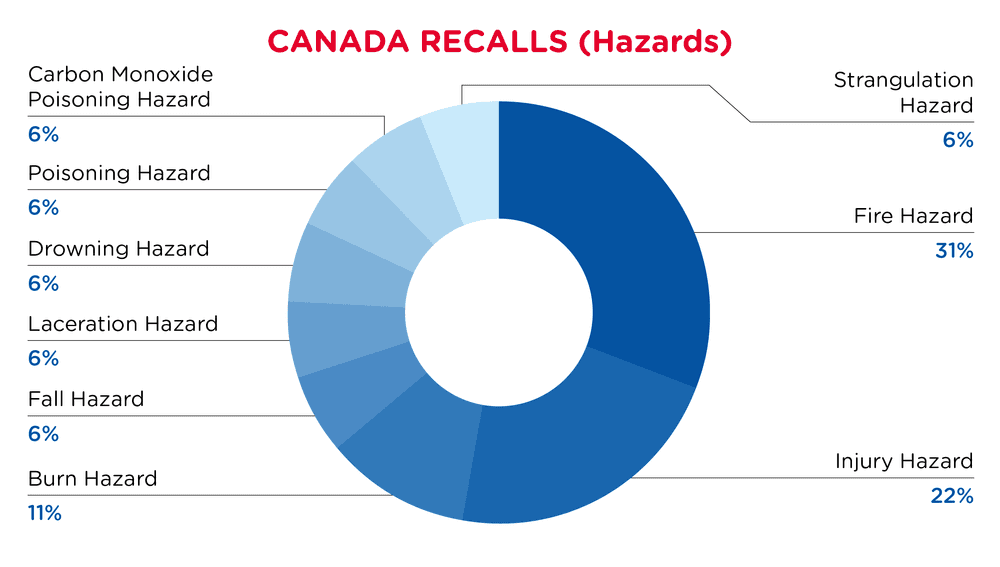
| Hazards | Frequency |
| Fire Hazard | 6 |
| Injury Hazard | 4 |
| Burn Hazard | 2 |
| Fall Hazard | 1 |
| Laceration Hazard | 1 |
| Drowning Hazard | 1 |
| Poisoning Hazard | 1 |
| Carbon Monoxide Poisoning Hazard | 1 |
| Strangulation Hazard | 1 |
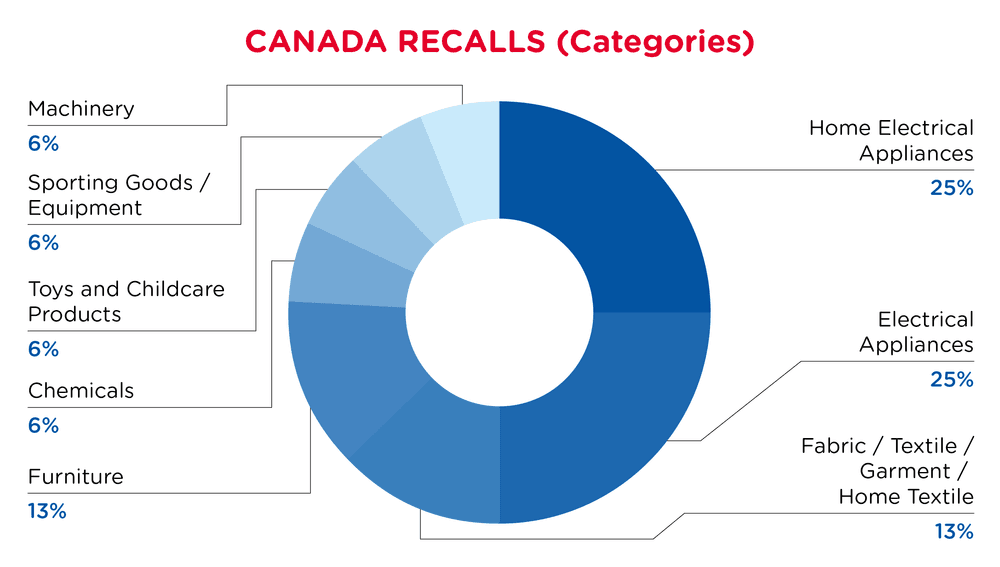
| Product Categories | Frequency |
| Home Electrical Appliances | 4 |
| Electrical Appliances | 4 |
| Fabric / Textile / Garment / Home Textile | 2 |
| Furniture | 2 |
| Chemicals | 1 |
| Toys and Childcare Products | 1 |
| Sporting Goods / Equipment | 1 |
| Machinery | 1 |
For a complete list, click here
Europe News
In Europe, when hazards are identified in non-food consumer products, the products will be recalled and published in the Safety Gate system, which is updated weekly. The European recalls from 01 October 2025 to 31 October 2025 are summarized below:
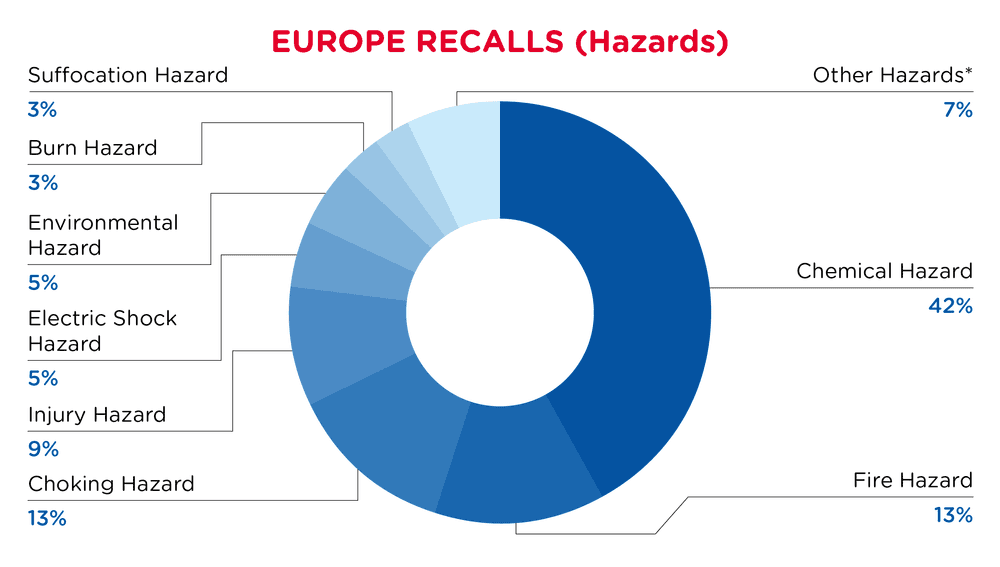
| Hazards | Frequency |
| Chemical Hazard | 201 |
| Fire Hazard | 63 |
| Choking Hazard | 61 |
| Injury Hazard | 42 |
| Electric Shock Hazard | 26 |
| Environmental Hazard | 25 |
| Burn Hazard | 16 |
| Suffocation Hazard | 15 |
| Other Hazards* | 35 |
*Other Hazards include Damage to Hearing, Strangulation Hazard, Cut Hazard, Health Risk Hazard, Drowning Hazard, Microbiological Hazard, Damage to Sight and Entrapment Hazard with a frequency of less than 10.
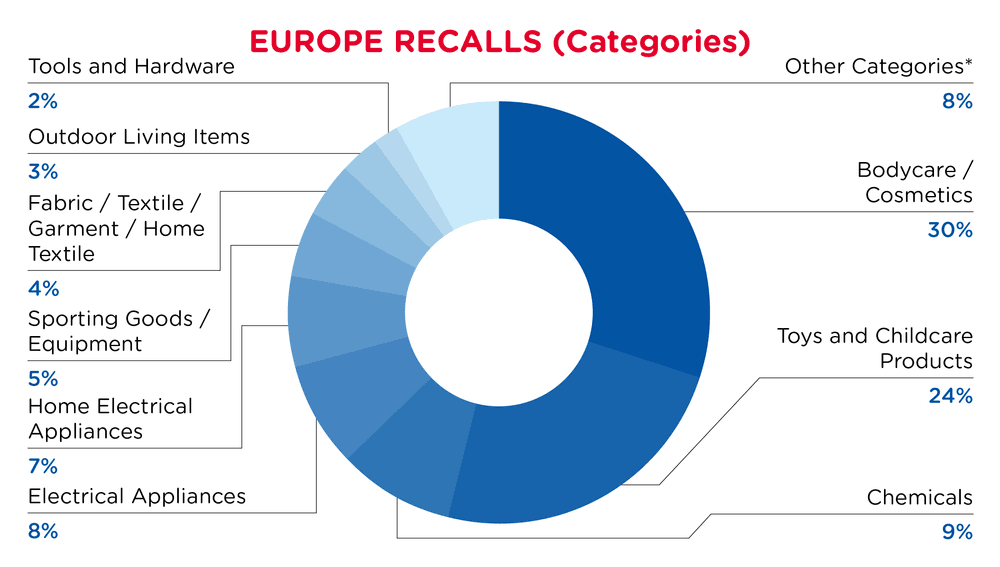
| Product Categories | Frequency |
| Bodycare / Cosmetics | 125 |
| Toys and Childcare Products | 97 |
| Chemicals | 38 |
| Electrical Appliances | 31 |
| Home Electrical Appliances | 27 |
| Sporting Goods / Equipment | 21 |
| Fabric / Textile / Garment / Home Textile | 16 |
| Outdoor Living Items | 14 |
| Tools and Hardware | 9 |
| Other Categories* | 34 |
*Other Categories include Machinery, Jewelry, Computer / Audio / Video / Other Electronics & Accessories, Household Items, Furniture, Protective Equipment, Accessories, Food Contact Material, Footwear and Car Accessories with a frequency of less than 8.
For a complete list, click here
ECHA announced that on 5 November 2025, 1,1'-(ethane-1,2-diyl)bis[pentabromobenzene] (Abbreviation: DBDPE) was included as a member of the SVHC Candidate List.
On 27 June 2025, the European Chemical Agency (ECHA) launched a 45-days public consultation on the substance, 1,1'-(ethane-1,2-diyl)bis[pentabromobenzene] (DBDPE), as a new potential Substance of Very High Concern (SVHC) with specifics shown in the table below.
After further discussion within ECHA’s Member State Committee, DBDPE was concluded to be a member of the SVHC Candidate List on 5 November 2025.
The number of SVHCs on the Candidate List is updated to 251 entries.
Details of this new SVHC candidate list’s member are summarized in the table below.
| Substance | EC no. | CAS no. | Reason | Usage |
| 1,1'-(ethane-1,2-diyl)bis[pentabromobenzene] (Abbreviation: DBDPE) | 284-366-9 | 84852-53-9 | vPvB* (Article 57e) | - Formulation of flame retardants - Thermoplastics in various sectors, including: -Electronic and electrical components and electronic enclosures - Construction (building, roofing) - Automotive (e.g. wires and cables) - Formulation of adhesives, sealants, coatings and inks - Wood plastic composite - Foam used in construction |
*Remark:
VPvB = very Persistent and very Bioaccumulative
Manufacturers and importers should take note of DBDPE and its potential and current use in their processes or products to plan accordingly.
The European Commission adopted Delegated Regulation (EU) 2025/1482, amending Regulation (EU) 2019/1021 on Persistent Organic Pollutants. It sets updated unintentional trace contaminant limits for certain polybrominated diphenyl ethers in mixtures and products, with thresholds varying by material source (virgin or recycled) and product type.
The measure takes effect from 17 November 2025.
Polybrominated diphenyl ethers (PBDEs) are a group of brominated flame retardants historically used in plastics, textiles, electrical and electronic equipment, and other consumer products. They persist in the environment, can bioaccumulate in living organisms, and pose risks to ecosystems and human health.
The European Commission adopted Delegated Regulation (EU) 2025/1482, amending Annex I, Part A of Regulation (EU) 2019/1021 on Persistent Organic Pollutants (POPs). This regulation introduces updated unintentional trace contaminant (UTC) limits for mixtures and articles containing PBDEs—including tetraBDE, pentaBDE, hexaBDE, heptaBDE, and decaBDE—based on their origin (virgin or recovered materials) and product type.
This amendment reflects updated science, detection capabilities, and EU obligations under international agreements, notably the Stockholm Convention on Persistent Organic Pollutants and the Protocol to the 1979 Convention on Long-range Transboundary Air Pollution. It supports the Union’s commitment to protect human health and the environment. Businesses must review their compliance strategies, particularly for recovered materials, toys, and childcare products subject to phased reductions through 2027.
The regulation recognizes that PBDEs in the EU market are now found predominantly in articles or mixtures manufactured from recovered materials. To manage technical feasibility and allow progressive adaptation by industry, differential UTC limits are applied depending on whether the product contains recovered material and whether it falls into sensitive categories such as toys and childcare products.
1. Requirement
Unintentional Trace Contaminant Limits (sum of tetra-, penta-, hexa-, hepta-, and decaBDE):
| Included Under Requirement | Limit from 17 Nov 2025 | Limit from 30 Dec 2025 | Limit from 17 May 2027/30 Dec 2027 |
| All mixtures and articles | 10 mg/kg | - | - |
| Mixtures/articles of recovered material | 500 mg/kg | 350 mg/kg | 200 mg/kg (from 30 Dec 2027) |
| Toys and childcare products of recovered materials | 500 mg/kg | 350 mg/kg | 10 mg/kg (from 17 May 2027) |
2. Exemptions
Food Contact Material (FCM) and articles are exempted from this regulation as these PBDEs, in principle, should not be present in these products according to Regulation (EU) No. 10/2011 on plastic materials and articles intended to come into contact with food.
3. Implementation
The restrictions on manufacturing, importing, exporting or using tetra-, penta-, hexa-, hepta-, and decaBDE start on 17 November 2025 (20 days after publication in the Official Journal).
The Executive Order of BEK nr 464 of 02/05/2025 issued by Denmark on 2 May 2025 is the implementation of the national ban on the import and sale of PFAS in clothing, footwear, and consumer‑use waterproofing agents for clothing and footwear.
Executive Order BEK nr 464 of 02/05/2025 took effect on 1 July 2025, with the actual enforcement of the ban commencing on 1 July 2026. This order represents the national ban on the import and sale of Per- and polyfluoroalkyl substances (PFAS) in clothing and footwear, and consumer-use waterproofing agents in Denmark. Main contents of this legal regulation are as follows:
1. Application scope
Clothing
Footwear
Waterproofing agents for clothing or footwear for private use
Textile products (personal protective equipment (PPE) excepted)
Exemption:
Recycled clothing or footwear
PPE
Medical devices
Transit cargo
2. Limit
Total fluorine content of 50 mg F/k
Note: Please note that the limit does not apply if the fluorine content comes from a substance that is not PFAS. That means the fluorine source may be inorganic chemicals. The Danish Environmental Protection Agency (EPA) may request documentation for this.
Effective 1 October 2025, the German Federal Institute for Risk Assessment implemented updates to its guidelines for nine categories of food contact materials and products. Eight recommendations were revised while one outdated recommendation was withdrawn. These adjustments aim to enhance consumer safety and align material standards with current scientific and regulatory developments.
The German Federal Institute for Risk Assessment (Bundesinstitut für Risikobewertung, BfR) revised several of its guidelines for materials and articles intended for contact with food. In total, eight existing recommendations have been updated, introducing stricter limits, new substance approvals, and updated testing methods. Additionally, one outdated recommendation has been withdrawn (without replacement).
Key changes include tighter migration limits for bisphenol A(BPA), new “not detected” requirements for acrylamide, expanded lists of permitted additives, and additional references to European Union (EU) regulations. The changes affect nine different material categories.
The intent of the revisions is to enhance consumer safety and align the guidelines with current regulatory and scientific developments. Parties should review the revisions for an understanding of the impact of the updates which became effective on 1 October 2025.
Main updates at a glance:
| Recommendation | Previous Status | Key Changes (October 2025) |
| Last updated February 2022 | • Added sodium hexametaphosphate to the list of permitted emulsifiers, with specific conditions. • Introduced a new additive category (“Category 3”) with requirements for microfibrillated cellulose. | |
| Last updated September 2024 | • Footnote 7 adjusted to require compliance with Recommendation XXV on paraffins and waxes | |
| Last updated July 2016 | • New footnote 1 limiting Bisphenol-A- diglycidyl-ether content to ≤ 2% • Explicit reference to EU Regulation 2024/3190 governing BPA and related bisphenols | |
| XXX – Conveyor Belts from Gutta-Percha & Balata | Recommendation from 1984 still in place | • Withdrawal of the 1984 version with no replacement. |
| Last updated August 2024 | • Footnotes 8 and 9 changes for colorfastness testing, specifying EN 646 and EN 648 methods and rating requirements • Acrylamide must be “not detected” (detection limit (DL) = 0.01 mg/kg) in final products • Expanded list of specified materials and additives • BPA migration limit tightened from 0.05 mg/kg to 0.01 mg/kg for recycled paper • Added requirement for Mineral Oil Aromatic Hydrocarbons (MOAH) content • Several footnote relocations and text changes, including Primary aromatic amines (PAAs) | |
| Last updated August 2024 | • Acrylamide “not detected” requirement introduced | |
| Last updated August 2024 | • Acrylamide “not detected” requirement introduced | |
| Last updated September 2019 | • Acrylamide “not detected” requirement introduced | |
| Last updated November 2014 | • Footnote 10 updated to require compliance with Recommendation XXV on paraffins and waxes |
China News
In China, when hazards are identified in consumer products, they will be recalled and published in the SAMR Defective Product Administrative Centre, which is updated daily. The China recalls from 01 October 2025 to 31 October 2025 are summarized below:
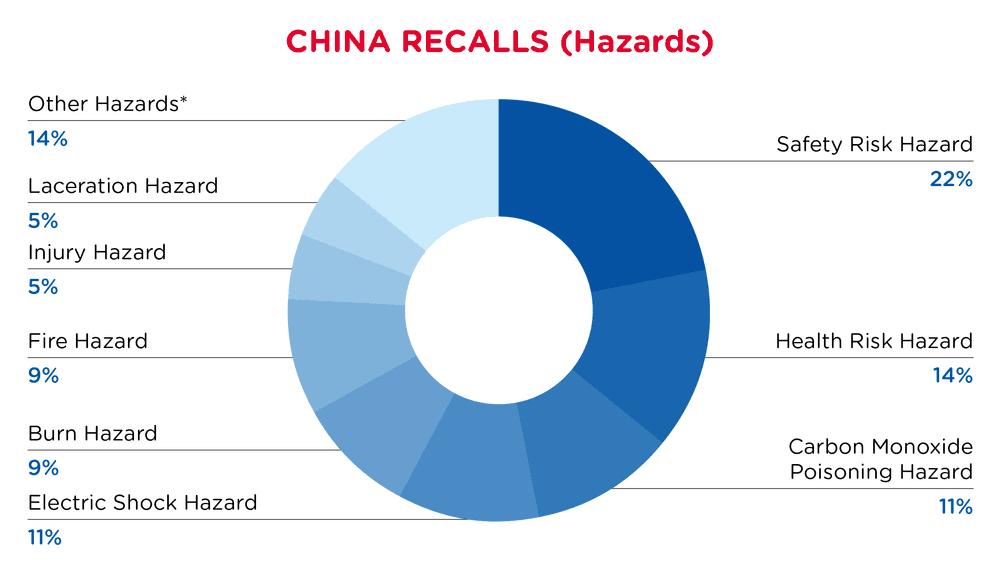
| Hazards | Frequency |
| Safety Risk Hazard | 10 |
| Health Risk Hazard | 6 |
| Carbon Monoxide Poisoning Hazard | 5 |
| Electric Shock Hazard | 5 |
| Burn Hazard | 4 |
| Fire Hazard | 4 |
| Injury Hazard | 2 |
| Laceration Hazard | 2 |
| Other Hazards* | 6 |
*Other Hazards include Fall Hazard, Explosion Hazard, Skin Irritation Risk, Entanglement Hazard, Microbiological Hazard and Suffocation Hazard with a frequency of less than 2.
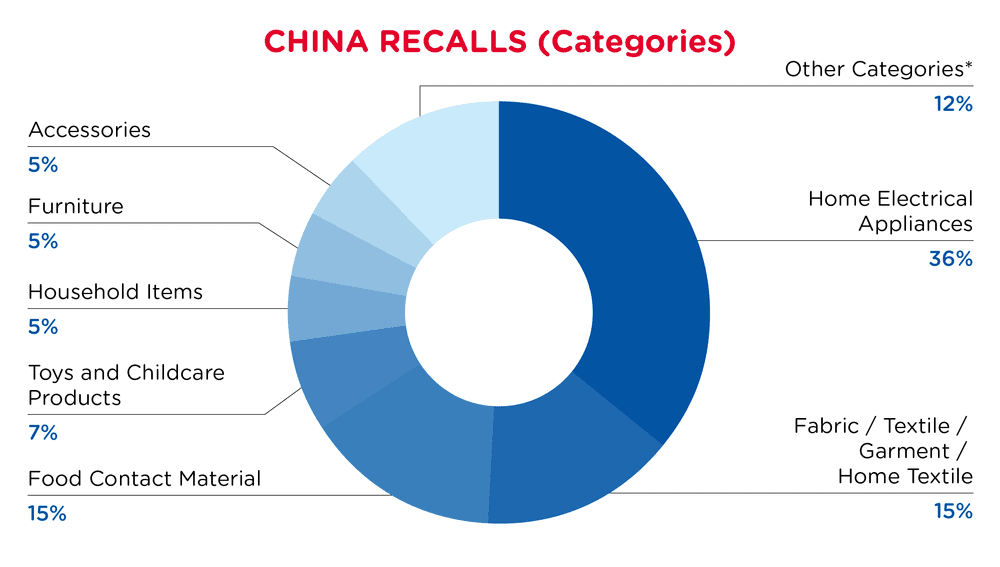
| Product Categories | Frequency |
| Home Electrical Appliances | 15 |
| Fabric / Textile / Garment / Home Textile | 6 |
| Food Contact Material | 6 |
| Toys and Childcare Products | 3 |
| Household Items | 2 |
| Furniture | 2 |
| Accessories | 2 |
| Other Categories* | 5 |
*Other Categories include Outdoor Living Items, Footwear, Stationery, Travel Items and Sporting Goods / Equipment with a frequency of less than 2.
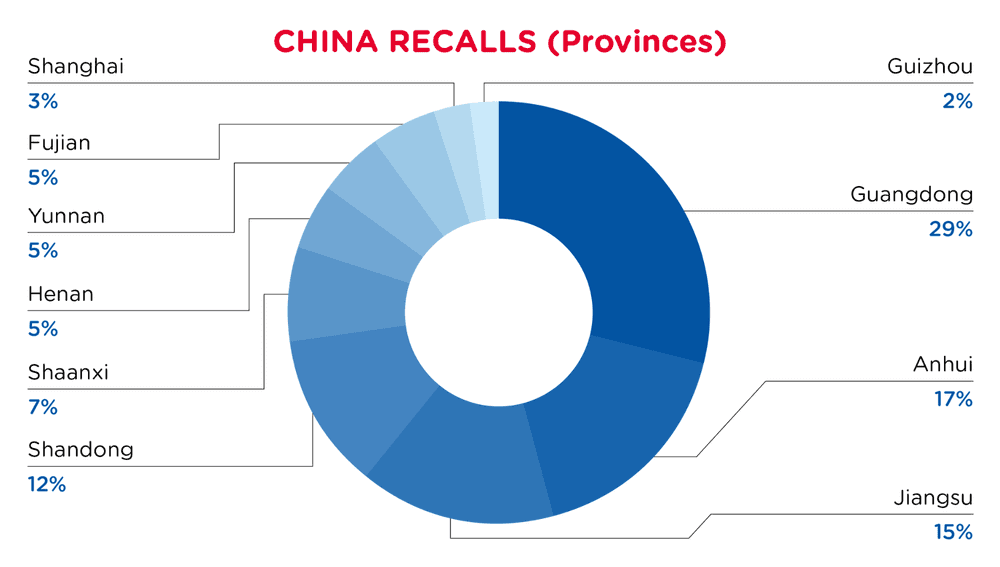
| Provinces | Frequency |
| Guangdong | 12 |
| Anhui | 7 |
| Jiangsu | 6 |
| Shandong | 5 |
| Shaanxi | 3 |
| Henan | 2 |
| Yunnan | 2 |
| Fujian | 2 |
| Shanghai | 1 |
| Guizhou | 1 |
For a complete list, click here
The latest standards for food contact coatings, GB 4806.10, and food contact silicone of GB 4806.16 in China have been published on 2 September 2025. The two mandatory standards will be implemented beginning 2 September 2026.
Two mandatory Chinese National Standards, food contact coatings, GB 4806.10, and food contact silicone, GB 4806.16, which were published on 2 September 2025, contain many changes.
GB 4806.10-2025 for food contact coatings replaced and repealed GB 4806.10-2016.
GB 4806.16-2025 for food contact silicone was divided from GB 4806.11-2016 which composited requirements for food contact rubber and silicone and had many updates. In 2023, GB 4806.11 was updated to the 2023 version which revised the rubber section only.
GB 4806.16-2025 for food contact silicone and GB 4806.11-2023 for food contact rubber replaced and repealed GB 4806.11-2016.
Please find the key revisions to these standards as follows:
| Standard of Food Contact Material | Section | Updated Requirement | Previous Requirement | Note |
| GB 4806.10 (food contact paints and coatings) | Scope | This standard applies to paints and coatings used in food contact applications. | This standard applies to paints and coatings used in food contact applications. This standard does not apply to paper paints and coatings. | “Paper paints and coatings” are additives for paper and paperboard materials and products. The finished coated paper/board products shall fulfill the requirements in GB 4806.10 (food contact coating) and GB 4806.8 (food contact paper/board). |
| Parameter of “Potassium permanganate consumption” and “Heavy metal” | Test condition of high temperature (boiling for 0.5h, followed by room temp. for 24h) is updated to cookware only. | Test condition of high temperature (boiling for 0.5h, followed by room temp. for 24h) is for cookware and drinking utensils. | / | |
| Parameter of “Primary Aromatic Amines (PAA) migration” | New requirement. | / | For coatings containing aromatic isocyanates and azo colorants only. | |
| Migration test | Added special requirement for food contact coatings on metal can (including can body, lid, pull ring, etc.). | / | For overall migration using 4% acetic acid, if the specimen has changes in actual use, such as coating peeling, blistering, or metal corrosion, an inert substrate can be used for sample preparation before testing. If this method is not feasible, 10% ethanol can be used instead of 4% acetic acid. However, this principle does not apply to specific migration test. | |
| Labeling | Remove the requirement of “coated material and product shall also list the material name of substrate and coating”. | In addition to complying with the provisions of GB 4806.1, the labeling shall also list the material name of substrate and coating. | / | |
| GB 4806.16 (food contact silicone) | Parameter of “Potassium permanganate consumption” and “Heavy metal” | Test condition is updated to 60℃ for 2 h. | Test condition was 60℃ for 0.5 h. | / |
| Parameter of “Volatile matter” | New requirement. | / | Test method is included in Annex B of GB 4806.16-2025. | |
| Migration test | Remove the special provision that “50% ethanol shall be used as the food simulant for oil foods”. | 50% ethanol shall be used as the food simulant for oil foods. | Food simulants shall be selected in accordance with "National Food Safety Standard - General Rules for Migration Tests of Food Contact Materials and Articles" (GB 31604.1-2023). |
In view of the revisions, it is important for interested parties to review to ensure the compliance of testing, labeling, etc. The two mandatory standards will enter into force beginning 2 September 2026.
The mandatory standards that have been updated for China apply to children’s products and child care articles. These mandatory standards were updated on 5 October 2025.
On 5 October 2025, the Chinese Standardisation Administration (SAC) and the Chinese State Administration for Market Regulation (SAMR) published updated standards that pertain to children’s products and childcare articles.
1. GB 46523-2025 on general safety requirements for children's products.
This standard outlines safety requirements, chemical limits, testing procedures, product manuals, technical specifications for children's products, and other relevant information under general requirements, mechanical and physical performance, chemical and electrical safety.
According to the draft text, the standard would apply to products designed or intended for use, play, wear, etc., by children under 14 years old, including trial and free products.
The standard enters into force on 1 November 2026.
The online preview of the standard will be made available at: https://std.samr.gov.cn//gb/search/gbDetailed?id=40C4523A3FAC1115E06397BE0A0AE2D3
2. GB 46516-2025 on the general safety requirements for child care articles.
This standard specifies safety requirements for child care articles, prescribes the product manuals, testing procedures, technical requirements for materials, shape, size, and other relevant information.
According to the draft text, the standard would apply to products designed or intended for infants 48 months of age or younger, as well as products clearly used to assist infants in sitting, bathing, general care, sleeping, holding, and child protection. These include, but are not limited to:
Baby strollers.
Baby walkers.
Tiltable baby rocking chairs.
Baby pacifiers.
Baby swings.
Baby cradles.
Baby swimming pool sets.
Baby playpens and cribs for similar purposes.
Children's seats for bicycles.
Safety guardrails for infants.
Baby bathing chairs.
The standard enters into force on 1 November 2026.
The online preview of the standard will be made available at: https://openstd.samr.gov.cn/bzgk/std/newGbInfo?hcno=0B29C2024A7C29E3CED23544F2D955EE
3. Among the 29 mandatory national standards that were approved and issued in October 2025, the below updated standards were the standards pertaining specifically to children’s products and childcare articles:
GB 46516-2025: General safety requirements for child care articles;
GB 46517-2025: General safety requirements for children's ride-on and activity articles;
GB 46523-2025: General safety requirements for children's products.
Manufacturers and importers should review updated standards to ensure compliance of their products.
The toy standards of GB 6675 series in China have been updated to the 2025 version and have been published on 5 October 2025. The GB 6675 Series will enter into force on 1 November 2026.
During the period of 5 to 10 October 2025, the mandatory national standard GB 6675 series for toys was adopted by the Chinese Standardization Administration (SAC) and State Administration for Market Regulation (SAMR).
During the development process of the updates, the requirements of standards and regulations related to toys such as ISO 8124-1:2022, EN 71-1:2014, EN 71-9: 2005+A1: 2007, the EU Toy Safety Directive (2009/48/EC), the REACH Regulation (EC1907/2006), and the US Consumer Product Safety Improvement Act (CPSIA) were referenced to directly evaluate technical content.
Main revisions are:
| New Standard | Key updates | # | Details |
| GB 6675.1-2025 Safety of Toys – Part 1: Basic code | Scope | 1 | The scope of non-applicability is expanded to include kites (except for kite string) |
| Definition | 2 | Various definitions are updated referring to EN 71 series and ISO 8124 series. | |
| Technical requirement | 3 | Mechanical and physical properties: - add the requirement for toys that children might mistake for edible toys. | |
| 4 | Explosive and flammable properties: - add the requirement for toys using open flame. | ||
| 5 | Chemical properties: - add the requirement of migratable Boron. - increase the species of Phthalates. - add the requirements of formaldehyde, AZO, polycyclic aromatic hydrocarbons (PAHs), nitrosamines and nitrosable substances, formamide and short-chained chlorinated paraffins (SCCP). | ||
| 6 | Electrical performance: - add requirements for internal toy components with voltages exceeding 24V. | ||
| 7 | Hygiene requirements: - add hygiene and odor requirements for plant seeds and raw materials. | ||
| GB 6675.2-2025 Safety of Toys – Part 2: Mechanical and physical properties | Definition | 8 | Various definitions are updated. |
| Labeling requirement | 9 | Add detailed requirements of labeling. | |
| GB 6675.3-2025 Safety of Toys – Part 3: Flammability | Definition | 10 | Various definitions are updated. |
| Flammability | 11 | - add requirement of “the airflow velocity in the test chamber should be less than 0.2m/s.” - note the purity of Butane and Propane should be ≥95%. - modify the position of burner and the rules of evaluation. | |
| GB 6675.4-2025 Safety of Toys – Part 4: Migration of certain elements | Definition | 12 | Various definitions are updated. |
| Chemical requirement | - add the limits for finger paints, toy cosmetics, crystal slime and similar toys. - add the limits of Boron for modeling clay and putty. - add two dewaxing procedures. |
All the standards are scheduled to enter into force on 1 November 2026.
In view of the extensive revisions, it is important for pertinent companies to conduct a comprehensive assessment of their needs across a multitude of facets, such as technological enhancements, replacement of testing apparatus and mandatory certification, etc., to improve and ensure the quality of toy products.
Australia/New Zealand News
In Australia, when hazards are identified in consumer products, they will be recalled and published in the Recalls and Safety Alerts Database on the Australian Competition & Consumer Commission website, which is updated daily. The Australia recalls from 01 October 2025 to 31 October 2025 are summarized below:
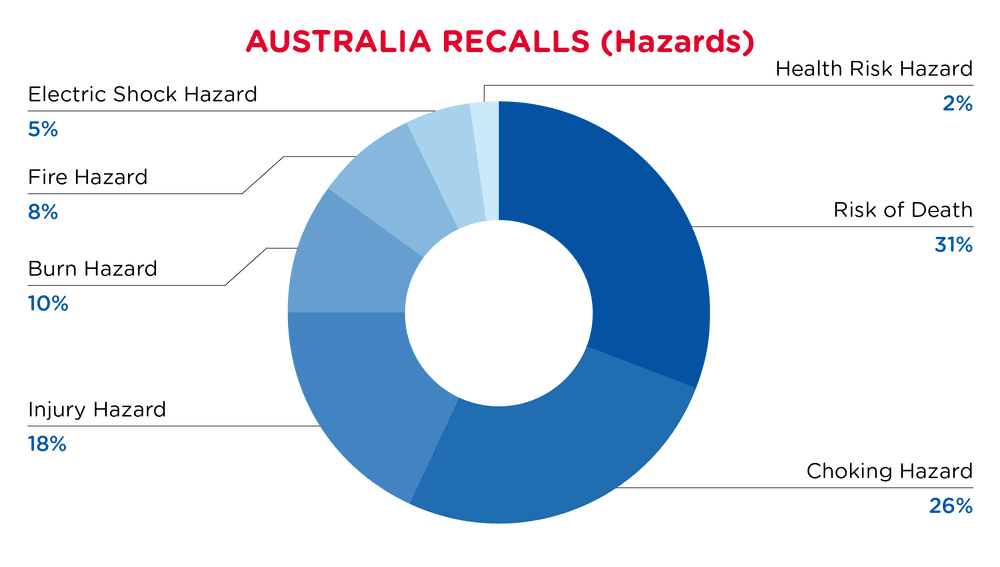
| Hazards | Frequency |
| Risk of Death | 12 |
| Choking Hazard | 10 |
| Injury Hazard | 7 |
| Burn Hazard | 4 |
| Fire Hazard | 3 |
| Electric Shock Hazard | 2 |
| Health Risk Hazard | 1 |
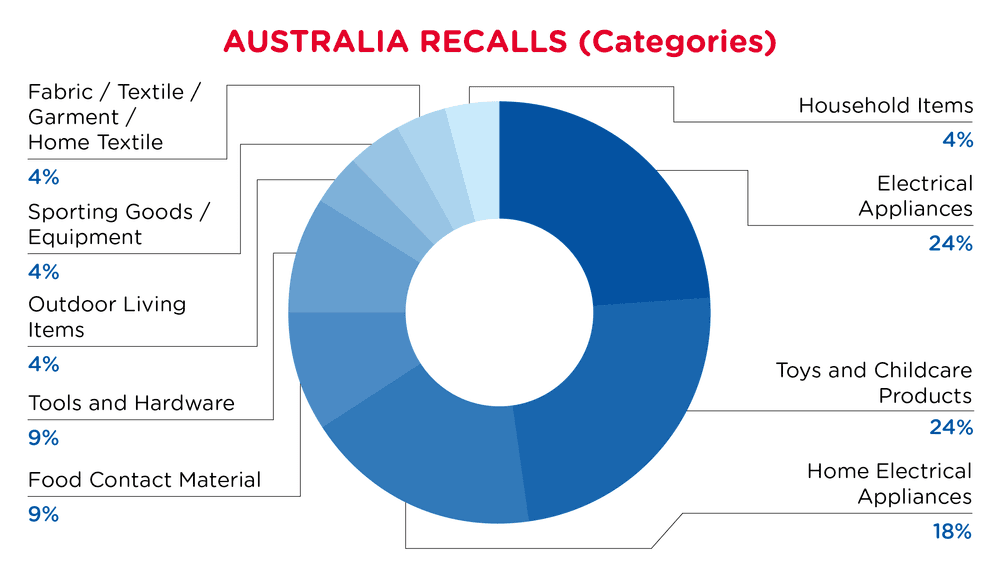
| Product Categories | Frequency |
| Electrical Appliances | 5 |
| Toys and Childcare Products | 5 |
| Home Electrical Appliances | 4 |
| Food Contact Material | 2 |
| Tools and Hardware | 2 |
| Outdoor Living Items | 1 |
| Sporting Goods / Equipment | 1 |
| Fabric / Textile / Garment / Home Textile | 1 |
| Household Items | 1 |
For a complete list, click here
Subscribe to our Regulatory Updates
Unsubscribe at any time. Read our privacy policy.